

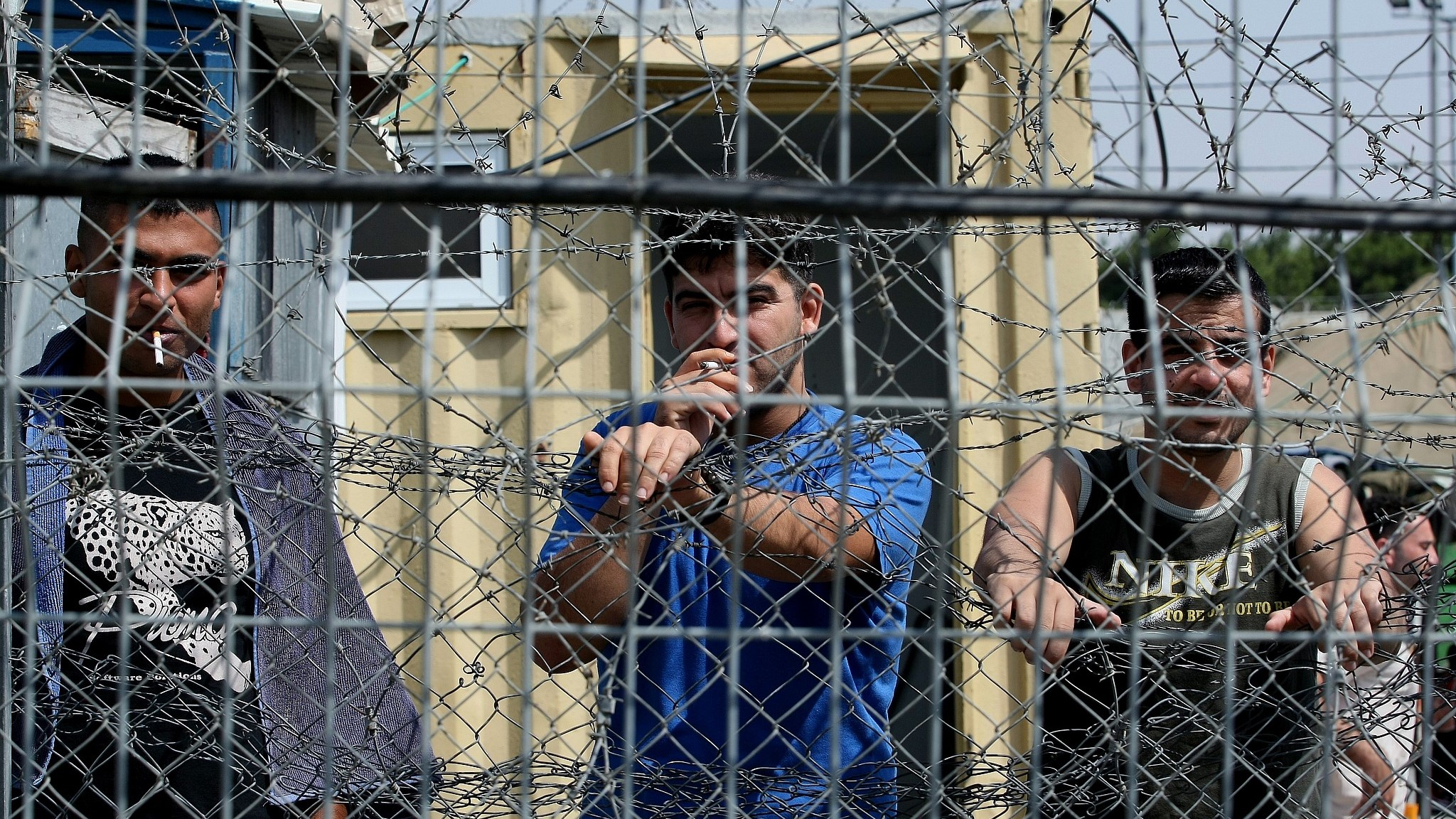
The Arabic word for confession — i’tiraf — also means recognition. A Palestinian prisoner who refuses to confess is refusing to recognize, let alone to legitimize, the colonizer’s power. This is the battle of wills at the heart of every Zionist dungeon. Ahmad Qatamesh, in his forthcoming book Interventions for Formulating the Alternative, traces the moral foundation of such a refusal: “[Revolutionary] work requires toughness, sumud, the acquisition of the skills of struggle, and not surrendering […] so these values become moral values, whereas betrayal, lying, and fragmenting the collective serve the enemy.” It is a creative and collective refusal, unsustainable by individual will alone, built on a full-hearted belief in the victory to come.
This belief has never been more sorely tested in the history of our struggle. “The door shut behind me, and a new life began within those corridors of slow death,” writes Hassan Salameh, who endured 500 days in solitary confinement, of the haunting threshold between life and death. “Everything was now unknown. There would be no one you would speak to, and no one who would speak to you.” Palestinians in the general prison population have historically maintained and fought for some ability to organize, to coordinate activity between cell blocks, and to sustain the elating pulse of comradeship. Since October 7, 2023, all this has been stripped away. Prisoners cling to bare life.
The martyred prisoner Walid Daqqa used “big prison” to describe a homeland under occupation and “little prison” for the architecture of the cells, where Zionism manifests in its purest, most malignant form. The prison is fortified by barbed wire, Hebrew legal code, and international impunity. Imprisonment itself steals childhood from children, abducts parents from their sons and daughters, and extracts leaders from the resistance movement. Despite all this, Palestinians have transformed the hellfire of prison into a kiln that forges the struggle. Leaders have emerged from the prisons’ torture chambers with wisdom on how to wage war against their torturers. From behind bars, writers like Daqqa and Wisam Rafeedie have produced literature that has moved the nation and the world alike into action.
The object of Zionism is the destruction of the Palestinian as a Palestinian. As former prisoner Hadeel Shatara puts it: “You take a hostage to do an exchange […] to achieve something. Israel imprisons Palestinians to end our existence.”
The prison walls mark the boundary of Zionist imagination. Every US-backed Israeli onslaught, incursion, and massacre must be understood as coterminous with the logic of the dungeon. The political prisoner tortured at Sde Teiman and the family buried under rubble in Dahieh are not separate victims of separate campaigns, but targets of a single colonial project whose existence hinges on annihilating what they cannot subjugate.
While we were putting together this issue, the US and Israel launched another front of genocide: a criminal war of aggression against Iran. A war which explicitly seeks the destruction not only of the sovereignty of a nation-state, but of “a whole civilization.” The war expanded into Lebanon, where the Islamic resistance joined into battle, determined to expel the Zionists from the lands they seek to occupy in the South. After Iran secured a ceasefire agreement that included Lebanon, the entity rained down more than 100 bombs in minutes — an interval that Netanyahu boasted about — flattening apartment buildings on residents’ heads and straining hospitals to capacity. The goal of this wanton annihilation is to punish the people of the South and turn them against the resistance, an objective that reveals how little the Zionists understand the people they aim to defeat.
“We support the war,” says Miriam Fneish in a piece co-published with The Public Source in Beirut, “because we believe the result will be victory — and the return of the prisoners.”
In this issue — a collaboration with the Palestinian Youth Movement — you will learn of hunger strikers who have turned their bodies into weapons. You will bear witness to the terror of electrocution at Sde Teiman. You will find yourself seated on the floor of Ashkelon prison among revolutionaries plotting their victory, hear the triumphant verses uttered in court by Ayham Kamamji after his recapture following the Gilboa prison break, and learn of the grassroots efforts to free Lebanese abducted from their land. And you will learn about the international campaign, Freedom for Palestinian Political Prisoners, which asserts the centrality of the prisoners movement to every facet of our fight for liberation.
This issue insists that across every site of confinement and ruin runs a current of refusal and resistance, gathering force and coalescing into a struggle that cannot be brought to its knees. As one of our contributors writes from Beirut, “Their machines may swarm the sky, but we are the keepers of the earth.”
This piece appears in the twenty-first issue of The New York War Crimes.
Sign up for updates on the Freedom for Palestinian Political Prisoners campaign here, follow the campaign here, and take action here.