

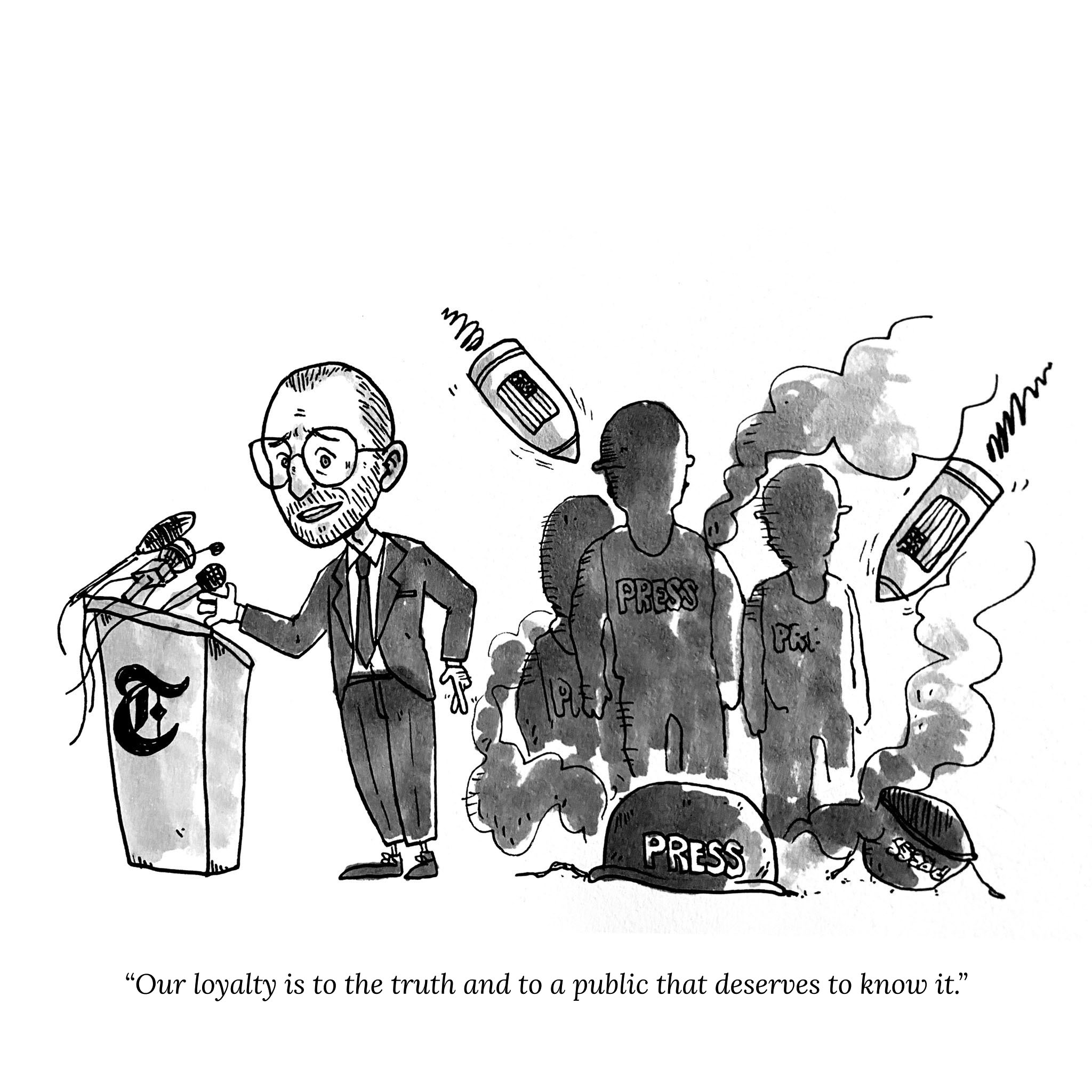
The early Zionists took the adage that winners write history and ran it in reverse: They wrote the history first, so as to win. What they rewrote was the history of a land; what they won was dominion over that land and its historic inhabitants. In this world-scale historical revisionism they have had many collaborators; but since the Nakba, and most definitely since the 1960s, their chief collaborator has been American mainstream media.
In 1965, the Palestinian scholar Fayez Sayegh described how the Zionist movement influenced the American press. His source was the American Zionist Council — the movement’s umbrella body in New York, funded from Jerusalem — whose own files the U.S. Senate had subpoenaed two years before. The Council’s methods, as Sayegh distilled them: “Cultivating editors, stimulating counteraction of press material hostile to Israel, drafting suggested editorials, and supplying editors with feature material which saves editors the time and trouble of doing their own research.” Pressed by Washington to register as a foreign agent, the Council handed its work to successors — AIPAC, then CAMERA, then HonestReporting.
The undeniability of the ongoing livestreamed genocide has stressed this arrangement. After decades of participation in the Zionist project of real-time historical revisionism, the American liberal media, freed from certain affective fidelities to White House narratives while Trump is the tenant, is turning its obfuscatory expertise to the smaller but no less sordid business of revising its own record of support for the genocide.
First there is the on-paper revision of the pieces themselves. In October 2023 the Toronto Star printed, as fact, the claim that Hamas had beheaded forty babies. When the claim fell apart, the Star deleted it and appended a note calling it unconfirmed — not false, just unconfirmed. A version of the same claim sat in a second column for another ten months. Postmedia’s papers ran the same claims and took over a year to append a single editors’ note. The Washington Post printed a claim from Israel’s defense minister that Hamas’s battle plans assigned commanders to rape soldiers; the next day it removed the quote with a brief correction saying it had not been authorized for publication — nothing about whether it was true. The New York Times reported that Israel held forensic evidence of systematic rape; days later it corrected the story to say Israel held no such evidence. And when Israel assassinated Anas al-Sharif, Reuters announced, “Israel Kills Al Jazeera Journalist It Says Was Hamas Leader,” then replaced the headline without a note. In no case did these outlets apologize for what the falsehoods did while they lived. In no case did anyone revise the hiring and editing practices that produced them.
Then there is the more general, sometimes abstracted revision of stance. A Polk Award is given posthumously to Mariam Dagga, a photographer for the Associated Press, killed in a double strike on Nasser Hospital six months earlier. The award has been funded in part by the Ochs-Sulzberger family, whose trust controls The New York Times; but no one in the room seems to find this contradictory, given The Times’s insistence, since the first weeks of the genocide, on publishing every Israeli account of a bombed hospital’s alleged ties to Hamas. The Committee to Protect Journalists, at a gala chaired by the publisher of The Wall Street Journal and hosted by CNN’s chief anchor, “honors” the martyred journalists of Gaza, among them al-Sharif, undoubtedly the most famous journalist the committee has ever failed to protect. The heads of the American institutions that helped spread Israel’s lies about these very journalists — calling al-Sharif an enemy combatant, therefore a legitimate target for an airstrike — sit at the $25,000 tables, clapping.
On May 11, 2026, Nicholas Kristof, a banner columnist in the Opinion pages of The New York Times, published a column on the rape and torture of Palestinians in Israeli custody headlined, “The Silence That Meets the Rape of Palestinians.” He did not say in whose pages that silence had been loudest. Had The Times been a serious newspaper, this would have been front-page news years ago. The column came only after two years of our Boycott, Divest, Unsubscribe campaign had raised the cost of the silence.
Why don’t we simply categorize the belated appearance of a report on Palestinian prisoner rape — a report that angered and maybe damaged the enemy — as a win for our side, and move on? Because from The Times and others, there is no accountability; and without accountability, there can be no real change.
Unfortunately for those who dream of a popular front with liberals against Zionism and fascism, the American right has better performed this accounting. Tucker Carlson, Candace Owens, Joe Rogan, and others have risked permanently alienating Zionists by admitting they believed and helped spread Israel’s lies. Whether or not it is opportunistic, this gesture extends to their massive audiences an opportunity to say it back: I was wrong. Liberals seem to find this more difficult. Ta-Nehisi Coates, who publicly and famously converted to the Palestinian cause in 2023, has too few fellow travelers on the road to Damascus.
Why is accountability so hard to extract? In every class, we are accountable to people we share tables with: dinner tables, conference tables, gala tables. Once you reach the gala, you become accountable to the worst people on earth. The New York Times answers to the Ochs-Sulzberger family trust. The Washington Post answers to Jeff Bezos, and Postmedia to a New Jersey hedge fund. And Zionists sit at the same tables: Joseph Kahn, the executive editor of The Times, is the son of Leo Kahn, who sat for nearly two decades on the board of CAMERA; at the press-freedom gala, five Murdoch companies bought a quarter-million dollars’ worth of tables. All of them answer to advertisers, where advertising still pays, and all of them answer to the state, which grants and withholds access: In October 2025 the Pentagon made reporters sign onto restrictive new press policies to keep their credentials (more than thirty outlets turned in their badges instead).
Ghassan Kanafani, writing in 1972 on publishing and political education, put it plainly: “Biased pedagogies that reflect the interest of the ruling class will not be changed through persuasion.” Persuasion — the appeal, the correction, the op-ed rebuttal — cannot dislodge what holds a class arrangement in place. The demand has to fall on the arrangement itself: on the tables and on what can be withdrawn from them — labor, copy, subscription, prestige.
When the courtyard of Al-Ahli Hospital exploded into flames on October 17, 2023, the papers, The Times among them, at first reported the facts on the ground. Then, under evident pressure, they retreated. Three days later, in the Opinion pages, Michelle Goldberg wrote, “It Is Impossible to Know What to Believe in This Hideous War.” The function of the column was to make the reader feel better about doing nothing. Since then, the WHO has counted attacks on all thirty-six of Gaza’s hospitals: bombed, besieged, set ablaze, many of them more than once.
The Times keeps a museum of its own history, opened in 2021 at its headquarters but closed to the public. The fuller mea culpas were already in print: Max Frankel’s essay on the paper’s Holocaust coverage, “a staggering, staining failure”; the 2004 editors’ note on Iraq; a 2018 apology for shameful AIDS coverage.
We are not waiting for the Gaza exhibit in the halls of shame. We seek accountability now.
Western journalists, Americans in particular, tend to think and act in terms of rights and freedoms. The Palestinian journalists of Gaza speak continuously in terms of responsibility and faith: “By God, I fulfilled my duty as a journalist,” said Hossam Shabat in his last will and testament, released after his martyrdom in Beit Lahia in March 2025. Anas al-Sharif, killed in the strike on the press tent at Al-Shifa Hospital in August 2025, framed his record as testimony offered before God. In his will he wrote that he never once hesitated to “convey the truth as it is, without distortion or falsification.” Wael al-Dahdouh, the Al Jazeera Gaza bureau chief whose wife, two of his children, and baby grandson were killed by Israeli fire in October 2023, and whose journalist son Hamza was killed by an Israeli strike in January 2024, has said the reporters he manages are duty-bound to carry on. “Otherwise there will be no one left to tell the story.”
Gaza’s journalists do speak of one right, which is the right not to be shot in the head while wearing a press vest and holding a microphone. The right not to be martyred while bearing witness to their people’s extermination.
Filming amid the rubble for World Press Freedom Day in May 2025, the Gazawi journalist Mohammed Abu Namous described to UN News the difficulties of working without electricity or internet. “The streets are now our offices,” he said.
The streets are now our offices. For Palestinian journalists, this is the condition. For Americans, it is a call to action. We urge our readers in the media to heed it while they still have a choice. Choose the streets, the tables, and the courtyards of the people. Refuse the highest office and the view that comes with it. Or one day, when the tide of reckoning breaches the walls, you will be unprepared for what comes next.
This piece appears in the twenty-second issue of The New York War Crimes.