

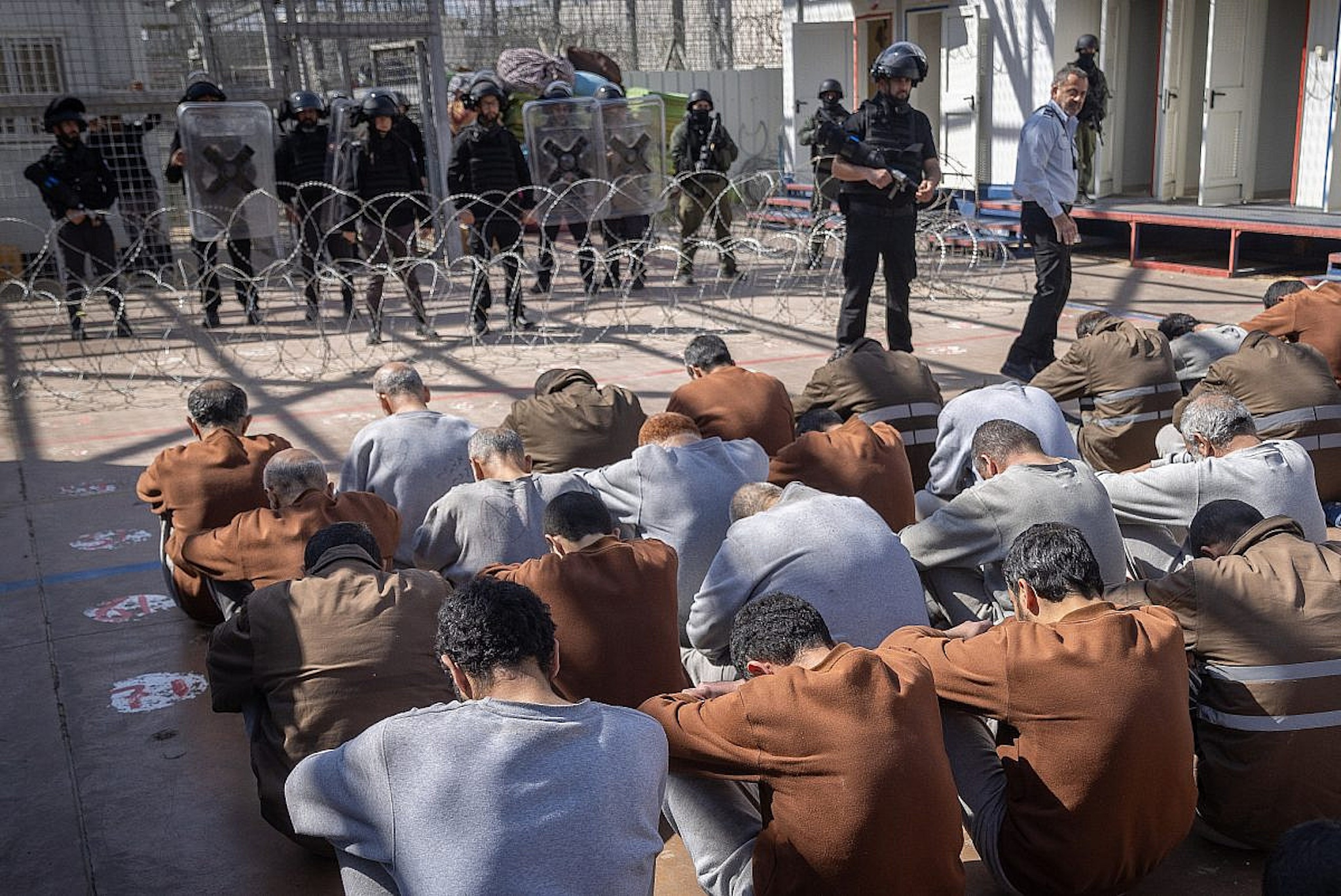
I will focus on the abuse that Palestinian prisoners are subjected to by Israeli soldiers at Sde Teiman, who we prisoners call the “butchers of humanity.”
I was arrested from Al-Shifa hospital alongside hundreds of injured and displaced, and taken to Sde Teiman military detention camp in Al-Naqab. The seven-hour trip — which usually takes less than one — was full of extreme torture and beatings. We suffered beatings on our heads, necks, and backs. We were burned, electrocuted and hurt in injured areas. The trip was seven hours of certain death.
When we arrived at Sde Teiman, the military captain responsible for the detention camp said, “ I don’t know if you believe in life after death or heaven and hell, but you have arrived in Israel’s hell and you will not leave alive.” He was very true in his words. Sde Teiman is not just hell, it is the lowest circles of hell.
In this hell, there was a standardized and set program of extreme torture, which I will outline in six types.
Physical torture
Beatings, electrocution, straining in what is known as the “ghost position” for extended periods of times, amputation of limbs, forcibly removing fingernails, and breaking joints and bones. There isn’t a single prisoner who has been in Sde Teiman that hasn’t had tens of broken bones. In my first months of detention, I would count my broken bones and I reached 19 and stopped counting. They even controlled the way we would sit. We were forced onto our knees for more than 18 hours a day, handcuffed and blindfolded. We would sleep for a couple hours and even that was interrupted with torture.
Torture by starvation
We’d receive food three times a day, and each “meal” consisted of three to four pieces of small toast, covered in mold. The prisoners would try to eat around it, which would leave them in total a small piece of toast; a spoonful of yogurt; and half a cucumber or tomato that was also moldy and unfit to consume. Once a month, we’d receive a spoonful of jam after they’d see that our blood sugar levels were so low due to the extreme deprivation of any sugar. The prison guards would throw the food at us, step on it, pour water, throw cigarette butts and garbage on it, allow animals or insects around it. All prisoners lost at least 30 to 40 kilograms from their body weight. I personally lost 42 kilograms during my year in occupation jails. There are prisoners who have lost 85 kilograms, the body weight of an entire human, because of the torture in Israeli prisons.
Sexual torture
The most extreme and difficult type of torture is sexual torture. This is done in multiple ways. The first is by completely stripping the prisoner of their clothes; secondly sexual harassment during interrogation, during transport from one cell to another, or during torture by Israeli soldiers, both men and women; the third is sexual assault and rape using solids like batons, hoses, and extinguishers; and the fourth is rape by animals trained to rape. During torture they would bring dogs trained to rape, strip the prisoners naked, and rape the prisoner in the cell in front of other prisoners. And the fifth way: rape by Israeli soldiers and guards. Based on testimonies from both men and women prisoners, Israeli soldiers would gang rape prisoners.
Dehumanization
The second a prisoner enters the prison he is transformed from a human being into a number and no longer called by his name. You are not allowed to change your clothes at all during the entire period of detainment, which usually ranges from one to five months.
I, personally, spent 100 days in Sde Teiman, blindfolded and handcuffed, without showering. Showering in Sde Teiman is three minutes with cold water without soap, once a week, without changing clothes, without changing underwear. Some of the prisoners had health complications, like urinary incontinence, and would stay in the same clothes, not allowed to cut their nails, not allowed to shave, and barred from speaking to anyone.
You’re also forbidden from speaking, from even moving your lips. If you did, the guards would give you the harshest punishment. They would tell you: “You are not human, my dog lives a better life than you.” They don’t see us as humans because if they did, they would not treat us this way. This was all intentional, as their goal was to destroy the prisoner psychologically.
Psychological torture
During the period when we were at Sde Teiman, we struggled through an extremely difficult psychological state. There were several methods used by the jailer, such as a disco room specifically designed with large speakers and loud music playing around the clock. This prevented the prisoner from controlling himself, from even thinking about the future or how he could mentally prepare to face the interrogation and the upcoming stages.
This was also done by completely cutting off news from Gaza while the war continued, so you didn’t know if your family was alive or not. Soldiers would lie and tell prisoners that their families were killed, and their wives and children were killed, which wouldn’t be true. Also, through the constant insults and shouting that never stopped around the clock. Prisoners were subjected to the most obscene and worst language, a type of oppression, abuse, and psychological torture.
Medical neglect
The last form of torture was through the collusion of medical staff with the state. All of these types of torture were intentional and systemic, and were approved at the highest ranks of the Israeli military.
We had broken muscles, broken bones, open wounds, and blood everywhere. But no one was seen by a doctor.
During an interrogation related to my journalistic work, I suffered severe fractures in my rib cage, resulting in a state of extreme unconsciousness. I needed to go to the clinic. And by the way, going to the clinic is a kind of torture. On the way back, you get beaten a lot, even by the so-called doctor — not a doctor, but a butcher. The doctor will beat you and deny you any medical treatment, use your wounds against you, and hurt your wounds even more.
I couldn’t breathe due to a blood clot in my chest. I insisted on seeing a doctor, risking the consequences. Only after 42 days did I see a military person who identified himself as a doctor. The doctor told me that I had broken ribs that resulted in internal bleeding, which leads to clots in the lungs. He told me in Hebrew, “Drink water, water is the cure for all illnesses. You complain of cancer, drink water. You complain of pain, drink water. Water is the solution for everything.”
Some prisoners had limbs amputated that did not need to be amputated, a result of deliberate medical neglect and the doctors’ eagerness to torture us.
One of the prisoners had a broken pelvis. The doctor took a picture of him, and told him “I will not help you, I will let you suffer until you die from the pain.” He suffered with a broken pelvis for an entire year, and was left to use the bathroom standing, with both hands and feet tied while blindfolded.
The authorities treat the journalist as an equivalent to the fighter. Before our release, we were threatened. If we returned to journalistic work or spoke about the conditions of detention, we’d face two options: to be killed with your entire family, or never-ending detention and torture.
Israel takes very seriously the impact of everything that is said and which takes hold in popular narratives, as it realizes deep down that it is an illegitimate entity — ostracized today and tomorrow and the day after — and so it lives in constant fear of the impact of the word.
It is essential to speak about the prisoners if we want to enact real change in this war. I do not mean speaking as a fleeting activity, I mean adopting the voice of the prisoners in a real sense in every arena, whether it be in the legal, media, or social arenas. This is our role towards people who are suffering and dying for no reason every day inside Israeli prisons.
Mohammed Qaoud shared this testimony during a Palestinian Youth Movement webinar on Palestinian prisoners. It has been edited for length and clarity. He holds a masters in journalism and media studies from the Islamic University of Gaza.
This piece appears in the twenty-first issue of The New York War Crimes.
Sign up for updates on the Freedom for Palestinian Prisoners campaign here, follow the campaign here, and take action here.