

Building Stadiums on a Mass Grave
FIFA wants to build stadiums on the ashes of Palestinians.
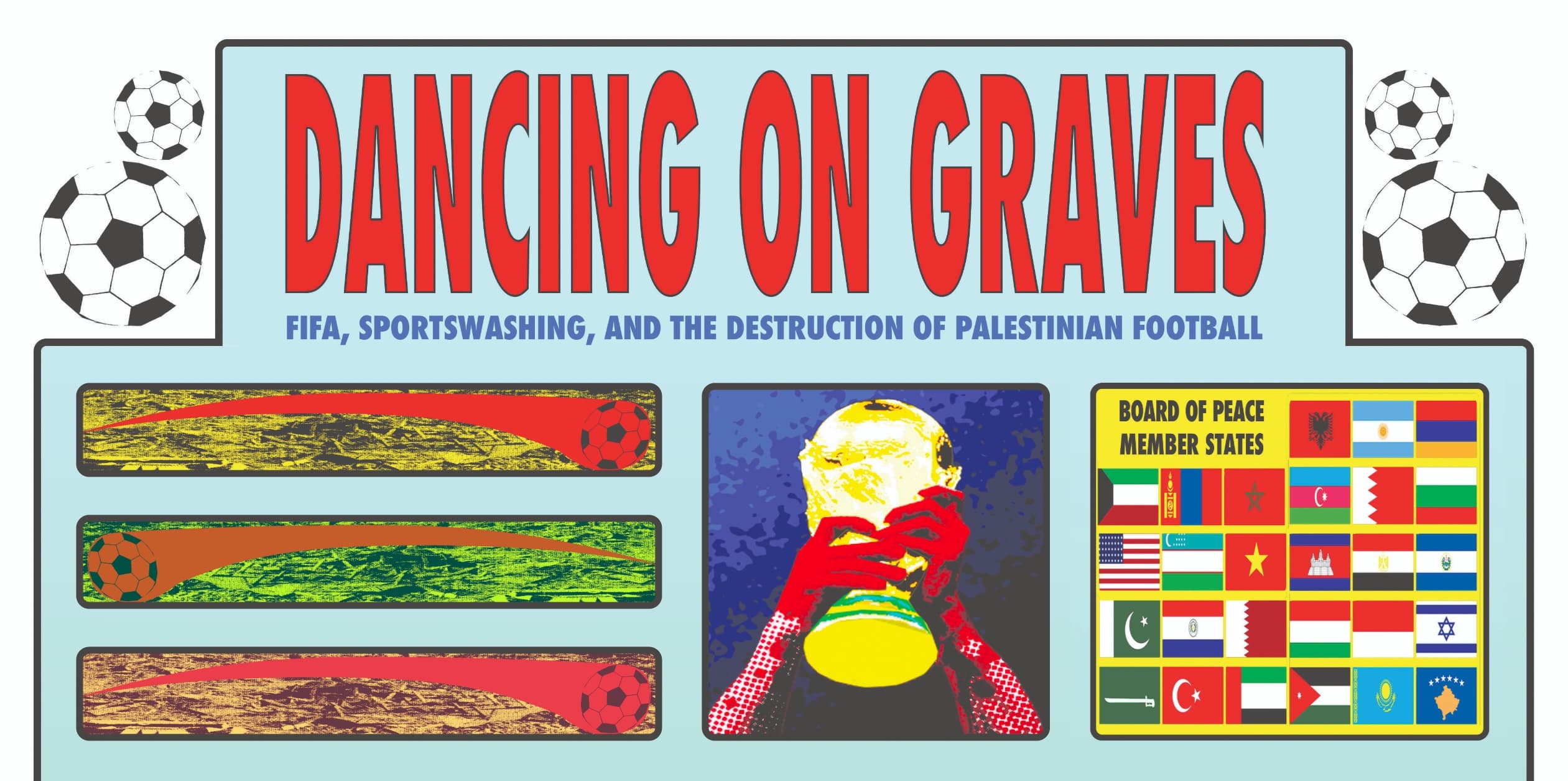
Through its partnership with the Board of Peace, a U.S.-led international body that uses the language of humanitarianism to legitimize the genocide in Gaza, FIFA has presented a vision of “recovery through football” in the Strip: 50 FIFA Arenas, a FIFA Academy, and a 20,000-seat national stadium designed to project an image of renewal. In so doing, FIFA is complicit in an endeavor that bypasses the international judicial system and circumvents any meaningful pathway for justice and restitution in Gaza in order to line the pockets of Donald Trump and his cronies.
But FIFA’s proposal turns Palestinian suffering into a backdrop for rehabilitating the organization’s tarnished image while skirting a central question: Who destroyed the Palestinian football that existed before?
Since October 2023, the Zionist entity has killed hundreds of athletes and sports workers. Clubs that once represented neighborhoods and families have lost generations of players. The infrastructure that sustained Palestinian football has been attacked, destroyed, or transformed into internal displacement camps.
Consider Yarmouk Stadium in Gaza, one of the Strip’s oldest, most revered and important sporting venues. Once a place where Palestinian athletes gathered to compete, train, and rejoice in the sport. The occupation converted the stadium into another vehicle of genocide — a detention site and torture center — before it became a shelter for displaced persons.
Across three years of genocide in Gaza, FIFA has repeatedly ignored international calls to hold the occupation to account for its war crimes. FIFA’s celebration of renewal is built atop the remains of those it failed to protect.
A stadium cannot replace a murdered player; a football academy cannot replace a lost generation; and FIFA’s ‘recovery’ plan is not a reprieve from Israel’s relentless assault on Palestinian life and infrastructure. FIFA’s self-aggrandizing reconstruction will not eradicate the stench of annihilation and murder.
A History of Corruption
FIFA’s response to the genocide in Gaza is part of its decades-long pattern of speaking the language of unity while prioritizing money, extraction, and political convenience.
Founded in 1904, FIFA’s reputation has long been marked by corruption scandals. The collapse of the International Sport and Leisure marketing empire in 2001 exposed the extensive bribery that underpinned FIFA’s commercial expansion. Allegations of corruption continued throughout Sepp Blatter’s presidency (1998–2015), culminating in 2015 when U.S. prosecutors indicted numerous FIFA officials on charges including bribery and fraud.
The same pattern of prioritizing profits over people is evident across FIFA’s World Cup decisionmaking. In 2022, following Russia’s invasion of Ukraine, FIFA suspended Russian national and club teams from all international competitions. Russia has since been locked out of major football events such as the 2026 World Cup qualifiers. But nearly three years into the genocide of Palestinians in Gaza, the organization has not taken similar action against the U.S. and Israel.
Instead of barring American and Israeli players from tournaments and demanding large-scale protections for Palestinian athletes and sporting infrastructure, FIFA awarded the U.S. hosting privileges for the 2026 World Cup. FIFA’s partnership with the so-called “Board of Peace” is yet another effort to sportswash its image.
The Destruction of Palestinian Football
The destruction of Palestinian football did not begin in October 2023. For decades, Palestinian athletes have been forced to compete under conditions designed to restrict movement, fragment communities, and limit their ability to develop a functioning sporting system akin to any other nation.
Players in Gaza and the occupied West Bank have struggled to travel across Palestine for games, often spending as much time navigating bureaucracy as preparing for international competitions. The sport has nonetheless survived, because football is not mere recreation, but a lifeblood of the people and a signifier of nationhood. A football club is a place where children can dream of a life beyond occupation and war.
Among the Palestinian footballers martyred in the occupation’s genocide on Gaza are:
Suleiman al-Obeid, also known as the “Palestinian Pelé,” one of the most recognizable figures in Palestinian football history — a former Palestinian international footballer who scored goals for both club and country. According to the Palestine Football Association, he was assassinated in Gaza in 2025 while seeking humanitarian aid.
Hani al-Masdar, also known as “Abu al-Abed,” a former Palestinian national team midfielder and coach of Palestine’s Olympic football team, killed in a January 2024 Israeli airstrike in central Gaza.
Muhammad Khalifa, a promising 20-year-old Palestinian youth international player, killed alongside members of his family in an Israeli airstrike on the Nuseirat refugee camp.
Rashid Dabour, a 27-year-old defensive player for Al-Ahli Beit Hanoun and the Palestinian national team, murdered in an October 2023 Israeli airstrike.
20-year-old Nazir al-Nashash, who played for Bureij Services Club, killed in another airstrike in October 2023 alongside family members.
Each was a player, teammate, coach, son, father, or future professional whose martyrdom marks the sport as a whole. Amid the carnage of genocide, we clearly see the deliberate erasure of a sporting generation.
Palestinian football does not need FIFA to arrive after the destruction with a branding campaign.
It needed FIFA when the players were alive, when the stadiums were still standing, and when there was still something left to protect.
FIFA’s Moral Depths
Under current president Gianni Infantino, FIFA presents itself as a global force for peace, reconciliation, and diplomacy.
But Infantino’s close relationship with Donald Trump demonstrates FIFA’s obsession with authoritarian political figures. Trump’s involvement in the 2026 World Cup makes it even clearer that external political interests and the forces of global power continue to shape the organization.
The organization’s response to the genocide in Palestine is the microcosm of this contradiction.
The same contradictions have appeared throughout football’s broader political landscape. Israeli clubs connected to settlements in the occupied West Bank are allowed to participate on the international stage, which normalizes illegal settlement activity. Fans of clubs such as Beitar Jerusalem F.C. have chanted “Death to Arabs,” attacked Palestinian workers, and in 2013 set fire to their own club offices in protest at the signing of two Muslim players.
Meanwhile, Mark Bonnick, a former kit manager for Arsenal, was fired from the club after expressing his support of the Palestinian people and his opposition to Zionism.
Then there are the controversies surrounding the 2026 FIFA World Cup. We all watched as Trump boasted on live television that he phoned in a favor to have U.S. striker Folarin Balogun’s red card postponed for the United States’ match against Belgium.
The tournament had already been tarnished by biased refereeing, the shameful treatment of the Iran national team, and other political pressures.
The bloody contradiction between FIFA’s language of brotherhood and the reality facing Palestinians was made painfully visible on the eve of Egypt’s World Cup match on July 7.
Mohamed Fawaz al-Waheidi, a senior official with the Egyptian Relief Committee in Gaza, was killed in an Israeli strike on a civilian vehicle in Gaza City’s al-Sabra neighborhood, according to reports from Palestinian and Egyptian sources.
Al-Waheidi was involved with an Egyptian humanitarian organization providing assistance to Palestinians in Gaza; he was also the lead organizer scheduling public screenings of World Cup matches in front of a backdrop of destroyed buildings and civic annihilation.
These screenings were a widely documented source of joy and enthusiasm for thousands of people in Gaza, and the Zionist entity targeted him for this reason.
FIFA’s response? Silence.
The Zionist obsession with exterminating all sources of hope and happiness for Palestinians gets swept under the rug as Gianni Infantino smiles, signs contracts, and gives a “Peace Prize” to Trump.
Following Egypt’s match, Egyptian coach Hossam Hassan spoke open-heartedly. Asked about Gaza, Hassan responded: “Does anyone know about those children who died? The ones whose legs were amputated, whose arms were amputated, and those who were blinded? Does anyone feel anything at all? In the country where children are dying, they wear Argentina jerseys. They wear Barcelona jerseys, they wear Manchester City jerseys, Real Madrid jerseys. You see, these people love you and love football. They’re being killed. And you just stay silent.”
The message from FIFA is clear: Politics are acceptable only when they protect its relationship with imperial powers. Sport becomes a mechanism not for confronting injustice, but for advancing it.
Why Sporting Boycotts Work
For decades, international sporting isolation became a weapon against the apartheid regime of South Africa. South Africa was expelled from FIFA, excluded from the Olympic movement, and increasingly isolated in rugby and cricket. These measures contributed to a broader campaign that stripped the regime of legitimacy and increased international pressure against it.
The message of these boycott campaigns was clear: A government that denies the rights of millions cannot participate normally in the institutions that claim to represent humanity.
We demand that football institutions live up to the values they claim to represent. That means refusing FIFA’s gestures of “reconstruction,” which are a substitute for justice. FIFA must end its allegiance to colonial power and focus on equitably governing global sport.
FIFA should suspend the Zionist entity from its competitions. Leagues must ban clubs connected to illegal settlements. The organization needs to apply its own stated principles consistently across nations.
Football is called the beautiful game partly because of its power to unite across differences. But unity and reconciliation in a world marred by atrocity cannot be achieved through alliances with imperial powers and systemic racism. It cannot be achieved with a public relations move to plan a stadium where bodies still remain under rubble. A ceremony cannot substitute for justice.
This piece appears in the twenty-second issue of The New York War Crimes.