

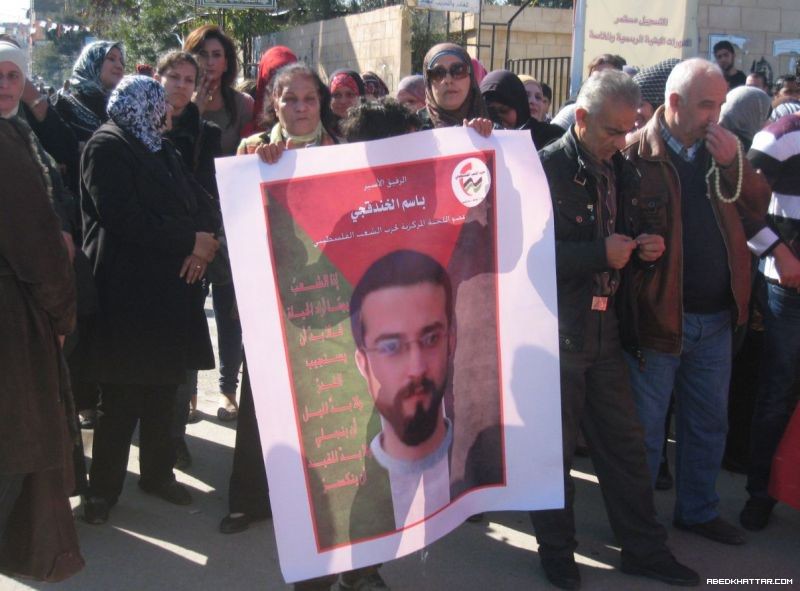
In his essay, “Studies from Prison: The Indomitability of Palestinian Knowledge Production,” Palestinian writer and former political prisoner Basem Khandakji analytically inverts the site of the Zionist prison from one of colonial repression and persecution to that of anticolonial intellectual production. The Prisoners’ Movement, he tells us, is the vanguard of Palestine’s intellectual front, sowing and nurturing a necessarily militant cultural consciousness. Just as Basil al-Araj maintained that the Palestinian intellectual must be engaged in anticolonial struggle, Basem reminds us of our imprisoned intellectuals, whose sustained engagement culminated in their very confinement, only to remain tethered to the cause, as both pillar and compass.
Basem commenced his studies at Al-Najah University in Nablus at the outbreak of the Aqsa Intifada. Already a member of the Palestinian People’s Party (an extension of the former Palestinian Communist Party), he immersed himself in student organizing, serving as Deputy Secretary of the Progressive Student Union Bloc at Al-Najah and engaging in grassroots mobilization initiatives on and off campus. He, like many of his people, was deeply affected by the killing of 4-month old Palestinian baby Iman Hajjo—the youngest martyr of the Aqsa Intifada—killed by an Israeli shell on Khan Yunis in May 2001. Iman’s martyrdom moved him and a group of comrades to form form the Vanguard of Free Leftists (طلائع اليساريين الأحرار). In November 2004, during his final year of university, Basem was arrested by the Occupation and falsely tried under three “life sentences.”
Following the intellectual contributions of his late friend, Walid Daqqa—whose body is still held captive in a Zionist prison morgue—Basem understands the prison not as a place but as a condition that aims to erode Palestinian revolutionary consciousness, transforming us from political actors into submissive subjects. Despite the colonial assault on his life and theft of his time and education, Basem, like Walid, wrote prolifically from his prison cell, publishing novels, poetry, and scholarly articles. His novel, A Mask, the Color of the Sky (قناع بلون السماء), won the 2024 International Prize for Arabic Fiction, which he only learned through the Shabak’s storming of his prison cell. In a recent interview, he describes the twinned spite and bafflement of the prison guards and Shabak interrogators, telling them “had I known my words would impact you to this degree, I would have written tens of books.” After over two decades in captivity, Basem was released in October of 2025 as part of the prisoner exchange secured by the steadfast Palestinian resistance in Gaza. Though outside the physical bounds of the Zionist cell, his colonial confinement persists through his exile to Egypt, denying him a true homecoming.
In his essay “Studies from Prison: The Indomitability of Palestinian Knowledge Production,” Basem pithily guides the reader through six historic phases of the Palestinian Prisoner’s Movement, recounting its sacrifices and achievements. The centrality of Gaza in this narrative is pivotal. Following the 2010 Qassam-led operation, “The Dissipation of Illusion” (عمليّة الوهم المتبدّد), which culminated in the capture of Israeli soldier Gilad Shalit, Palestinian student prisoners were legally barred from Zionist universities they had previously enrolled in. This led to the development of the first Palestinian educational program for prisoners in 2010, an initiative spearheaded by Al-Aqsa University in Gaza, cultivating over a decade of prisoners’ education and knowledge production. The buildings, facilities, faculty, staff, and students of Al-Aqsa University have since been targeted by the Israeli occupation, the ruins of the university’s bombarded campus converted to a camp for displaced Palestinians. Parallel to the Israeli bombing of Gaza’s schools and universities, Palestinian prisoners have been denied books, pens, and paper. The calculated assault on Palestinian educational infrastructure and knowledge production is integral to the genocidal reproduction of Zionism. Against all odds, Gaza’s teachers and students continue to congregate and learn in tents, and Basem, who faced prolonged torture and interrogation for his writing, went on to mentally compose an entire book in memory of Walid.
Despite its recent publication in the summer 2025 double issue of the Journal of the South [Al-Janoub], the context in which “Studies from Prison” was originally produced has dramatically transformed. Al-Aqsa Flood, itself a prison break that set in motion cascading prison breaks, has accelerated the always-already genocidal telos of the Zionist entity. The conditions in Zionist prisons have since acutely deteriorated, with prisoners subjected to an escalation in systematic rape, torture, starvation, and deprivation at the hands of their jailers. Arrests are at an all time high; former prisoners are closely monitored and under constant threat of rearrest; and freedom tenuously hangs in the balance between martyrdom, fugitivity, and forced exile.
Zionism’s failure to rewire Palestinian consciousness has culminated in its suicidal implosion. We see this today in Sde Teiman, which publicly operates as a rape and torture camp; in the literal unmasking of its rapist wardens, celebrated by settler society; and in the image of Ben Gvir, posing with a noose as he lobbies for the execution of Palestinian prisoners. The logic of coloniality is condensed in the prison, making the prison break, from above, below, and within decisive in the project of liberation. Basem theorizes one such method of prison break, laying the epistemological groundwork for the next.
Editor's note
Originally published as Basem Khandakji, “Dirāsāt min al-sijn: al-jurʾa fī intāj al-maʿrifa,” Al Janoub: The Palestinian Journal of Liberation Studies, no. 1 (Summer 2025): 102–19. The version presented here is a reprint of the English translation [Studies from Prison: The Indomitability of Palestinian Knowledge Production], first published in Jerusalem Quarterly, no. 104 (Winter 2025): 44-59.
Abstract
This paper assesses the context and methods that informed the work of the Palestinian Prisoners’ Movement in Zionist colonial prisons, aiding the prisoners in establishing an academic structure that combines learning with teaching and knowledge production over the six decades since 1967. While Palestinian prisoners engaged in the political and cultural life of Palestine from their position in captivity and throughout their decades of imprisonment, they managed to create a liberatory prison-based epistemology that exceeds the conventional concept of “prison literature.” Using an auto-ethnographic approach, coercively imposed upon the author, who was himself a political prisoner in Zionist jails for over two decades, this study has three aims: first, to examine the stages and general characteristics of the intellectual current emanating from the “parallel time” of Zionist prisons; secondly, to coalesce the resulting intellectual, literary, and artistic productions emerging from this context and attempt to institutionally situate them, in cooperation with Palestinian national institutions and others engaged in prison and liberation studies; and thirdly, to attempt to unshackle Palestinian prisoner-intellectuals from the grip of Western and Zionist colonial methodological and theoretical hegemony – as they continue to restrict prisoners’ intellectual output.
In his critical commentary on a study I had conducted using Western epistemological frameworks, my friend Professor Abdul-Rahim Al-Shaikh told me that it was high time we dispense with certain Western assumptions and theories so that we can more effectively attend to the phenomena and problematics we face in the Zionist colonial system of occupied Palestine. His comment awakened me from my slumber of modern and postmodern literary consumption, particularly since I have been preoccupied with the topic of boldly speaking out – that is, narrating our Palestinian story within an anti-colonial context, free from the epistemological shackles of Western theory. Following Al-Shaikh’s comment, I asked myself: To what extent can we, Palestinians subject to Zionist occupation, establish a liberating intellectual current similar to other liberatory schools of thought, such as the Nueva Izquierda (New Left) in Latin America or the Subaltern Studies school in India? If we liberate ourselves from Western epistemological assumptions that arose in the context of Eurocentrism and the colonization of the world, will we fall into the trap of nationalism in its insular, racist form? Will we stagnate in the quagmire of pseudo-authenticity, or might we establish a truly liberating epistemology? These are the pressing questions my friend, Abdul-Rahim, left me with – not to extinguish debate, but to generate further lines of inquiry.
Having been held captive in Zionist jails, I realized the potential of the prison as a site from which to develop alternative methodologies and ways of knowing. The prison – an “other” place and time, or a “parallel time” in the words of the martyred prisoner Walid Daqqa – despite being the site in which the Palestinian body is physically confined, does not necessarily succeed in confining the will, consciousness, and critical, emancipatory spirit of Palestinian prisoners in their pursuit of a liberated world. It was precisely here, in the Zionist prison, that I was astonished by my own outlook: devoid of hatred, vengeance, and the reactionary ills of nationalism despite the confinement of my body and my freedom by the Zionist colonial entity. I refused, and continue to refuse, to practice the same repressive measures against the colonizer, should I ever overcome him and taste victory.
I also extended this principle to the superstructure, so to speak, to the world of ideas that I drew upon and was influenced by for many years before recognizing it is shaped by Eurocentrism, and therefore not immune to the poisons of Western supremacism and arrogance. It is a world I have not shunned, nor will I impose upon it the same perspectives, methodologies, and epistemologies that it imposed upon me. On the contrary, I will transcend it in a dialectical manner, for from expropriation comes emancipation, and from the prison, liberation. But this can only be achieved when we colonized subjects can shatter our colonial existence by producing and embracing a militant culture. This culture is characterized by a progressive and universal humanism that renounces exclusion, marginalization, discrimination, categorization, and neutrality. Here, the prison becomes a distinct cultural space from which we observe the underlying and the overt realities of the world, without the prisoner having any actual, tangible participation in these realities and their manifestations. Instead, the prisoner writer emerges to offer a notable contribution as an engaged intellectual, continuously devoting themselves to ideas that transcend the temporal and spatial confines of the prison and the predetermined rules, methods, and foundations of Western knowledge systems.
In this study, I aim to analyze the prison as a cultural and intellectual locus cultivated by Palestinian prisoners since 1967, with the crystallization of the Palestinian Prisoners’ Movement in the Zionist carceral system. I do so by seeking to answer the central question: To what extent might the prison constitute an alternative critical epistemological and cultural current? I pose this research query in tandem with other questions, including: To what degree can politics and currents of knowledge external to Western knowledge systems shape the trajectory of imprisonment in the Palestinian context? What is meant by the prisoner’s “parallel time”? What techniques does the colonial apartheid system use to control, subjugate, and silence prisoners? And to what extent can Western theory, in our case, Pierre Bourdieu’s theory of scholasticism, form a basis for prison studies?
In order to address these questions, I established a distinct epistemological approach based on a dynamic, dialectical relationship between Western epistemological frameworks and the need to break free from them. This is complimented by my collection and collation of material on the historical contexts influencing prisoners’ writings, guided by my personal, lived, and ongoing experience of detention and confinement in the Zionist prison system.
The Myth of Epistemological and Academic Neutrality
Can the prisoner resolutely engage with a reality from which they have been excluded, confined to the depths of a detached space and time? The Palestinian prisoner writer/intellectual, consigned against their will to a marginalized category over long decades, has sought to establish their own cultural position so they can turn toward a world from which they have been forcibly severed. In order to assume this position, the prisoner-intellectual faces various methodological and conceptual hurdles that serve as a gateway to the world of knowledge outside the prison walls. To avoid falling captive once again, this time to Western epistemological assumptions incommensurate with their reality, the prisoner-intellectual must venture to develop their own methods and standards for understanding themselves and the world around them. As the prisoner-intellectual begins to move along the path of Western knowledge systems, they find themselves at an impasse with the assumptions of “epistemic neutrality,” “scientific objectivity,” and “critical detachment,” only for their work to assume the voice of an “other,” striving to climb the towering pyramid of epistemological hierarchy with its Western positionality, and ultimately finding themselves trapped in a liminal “in-between,” neither here nor there.
The possibility of developing local modes of knowledge production within colonized and marginalized communities, or within the prison in our case, lacks academic legitimacy according to Eurocentric epistemology, because our knowledge production does not adhere to the established methods and norms of the Western academy. In other words, the subjugated is denied their own epistemological framework and compelled to adopt the methodologies and foundational references of their powerful, hegemonic “other.” Moreover, the concept of epistemology, or the theory of knowledge, concerns the means of systematically and consistently acquiring knowledge and building clear concepts that subsequently become established traditions. Here, too, lies another implicit problem, as the methods of knowledge acquisition were historically shaped during the heyday of colonial expansion.1 This results in knowledge itself becoming a colonial construct capable of producing its own assumptions, obsessed with control and imbricated with power. What follows is a process of cultural export that “marginalizes any alternative, silences the ‘other,’ and advocates for a singular, universal truth based on a hegemonic Western episteme.”2
This hegemonic Western knowledge, in its expansion across the space-time of the non-Western world, also produces numerous obstacles for the local marginalized intellectual as they strive to study and analyze their own reality. In this context, it is important to note that Palestinian knowledge production faces various obstacles, particularly since the globalization of the Palestinian struggle against Zionism opened up the Palestinian reality to many Western researchers. According to Palestinian sociologist Abaher El-Sakka, this Western academic intervention has led to a number of dilemmas for the local Palestinian researcher, the most important of which are:
The difficulties associated with some scholars’ notion of the duality between objectivity and subjectivity in their research and research choices, their selection of topics, and their questioning of what constitutes acceptable scientific discourse. Due to the hegemony to which Palestinian society is subjected, researchers in the social sciences, for example, face numerous difficulties when describing the colonial condition in which they live and operate under the oversight of a regulator/donor, which requires them to adopt a discursive framing that articulates their condition as a conflict with another party, effectively equating the colonizer with the colonized under the pretext of objectivity.3
As for the sociological dimension, Palestinian sociology encounters multiple obstacles, most notably the inability to “develop a critical sociology that breaks with colonial knowledge, hindering its capacity to advance its own tools and approaches, and to incorporate concerns of the Global South related to the deconstruction of colonial knowledge. This has led some researchers to adopt imported methodologies, concepts, and analytical models, applying them to the local reality without critically examining their foundations, backgrounds, means of implementation, and historical context, which differs from the Palestinian context.”4 These difficulties can be overcome by demonstrating the importance of the politics of knowledge in determining the epistemological approaches of the marginalized researcher or, in this case, the prisoner writer. Here, the politics of knowledge plays a crucial role in framing the researcher’s perspective and challenging the Western academy’s “law of critical distance,” for “the sociologist is, above all, an integral part of society, which makes maintaining a minimum preferred distance between the researcher and their subject a difficult task.”5
The prisoner’s space-time is free from the burdens of Western knowledge that confronts those living in the space-time outside the prison. As the prisoner-intellectual formulates their ideas and generates knowledge, they engage in a double act of liberation: first, from the spatial and temporal constraints of the prison; and secondly, from the epistemic enclosure of Eurocentrism. Furthermore, by recognizing their capacity for autonomous knowledge production, the prisoner-intellectual frees themselves from Western epistemic hegemony. In order to confront, deconstruct, and dismantle the epistemic and metaphysical hierarchy, Laura al-Khoury and Saif Da‘na call for:
Indigenous research to be a form of resistance in its formulation of knowledge and to be with rather than about indigenous peoples, produced by the local community as historical agents, folklore transmitted through generations, and other culturally appropriate practices. Such knowledge is produced under the shadow of colonialism and does not submit to imposed theoretical projections.6
Liberation from Western knowledge and its perpetuation requires cultivating cradles of critical knowledge among indigenous peoples. This is what the prisoner-intellectual strives for: to meticulously deconstruct the problematics of space and time outside of prison, reframing them with the aim of dismantling their underlying assumptions. Such a project undoubtedly stems from the prisoner-intellectual’s integrity, tenacity, and indomitable commitment to representing their marginalized class and their indigenous community’s epistemic politics, without the confusion, distress, or anxiety wrought by Eurocentric epistemology. The prisoner-intellectual therefore engages with the problem of knowledge production, and not just knowledge itself.
Carceral studies, which read and analyze the prison as a parallel space-time, following the work of Walid Daqqa, and articulate it as a cultural and intellectual platform, have succeeded in breaking the hegemon-subaltern dichotomy. This field has boldly confronted the relentless persecution carried out by a colonial entity, the Zionist occupier, against the body, place, and time of the colonized Palestinian. By relying on a dialectical methodology grounded in descriptive analysis and sociocultural critique, these studies have not and will not fall captive to either academic subordination or narrow sectarian and racist parochialism. Such studies offer visions of a humanistic, universal, and inclusive nature, one in which the prisoner-intellectual has always aspired to in their parallel incarcerated space-time, where their bodies, cultures, and words continue to be confiscated and persecuted by Zionism. Palestinian prisoners, and the prisoner-intellectual in particular, were able to confront and overcome these constraints through their indomitable conviction, steadfastness, awareness, and defiance – this is what I will highlight in the following section.
The Historical Context of Palestinian Imprisonment
Following the 1967 Naksa and the complete occupation of all remaining Palestinian land by the Zionist colonial regime, Zionist prisons became overcrowded with freedom fighters and all those who resisted their occupation. This marked the emergence of what came to be known as the “Prisoners’ Movement” (al-haraka al-asira) in the prisons of the Zionist occupation. The history of the Palestinian Prisoners’ Movement is often divided by scholars into three phases: Foundation (1967–77); Maturation (1977–84); and Blossoming (1984–93). Three more phases can be added to complete the general historical arc of the Prisoners’ Movement, as follows: Stagnation (1993–2000); Reestablishment (2000–2009); and the Incarcerated Academy (2010–present).7 Without delving into the details and the general history of the Prisoners’ Movement, this section will focus on the historical context of the development of prison writing and its conditions. The first phase is considered the most difficult and brutal as Palestinian prisoners sacrificed their bodies to obtain cultural and organizational rights. Up until their demands were met and they were able to use pen and paper and receive books, Palestinian prisoners had been writing on canned food labels and clothing.8
The prisoners’ struggle, which was mainly represented by hunger strikes to secure the most basic human rights, emerged as a reaction against the torture policies of the Zionist “prison administration,” implemented to break the will of prisoners and reduce them to mere numbers. This authority’s aim, to dismantle the Palestinian’s humanity, prompted them to create new means to break the will of prisoners through policies and techniques of intervention, disruption of space, confiscation, and searches. Even the educational and written material produced by Palestinian prisoners is made into a burden, as:
whatever is written in a notebook is classified, in the occupation’s lexicon, as a form of incitement, and therefore a security threat to a state that has immense military capabilities. Thus, prisoners’ notebooks were subjected to a real “hunt,” with search campaigns focused on finding and confiscating anything written.9
The general features of educational and cultural life during the foundational stage were therefore limited to organizational and party-based training, literacy programs, and general secondary education.
The second phase (1977–84) was characterized by the consolidation of prisoners’ rights, following a series of hunger strikes that achieved some demands related to daily life in prison. This helped secure guarantees for the development of cultural and intellectual activity, along with the maturation of the organizational structures of factions within the prisons, which contributed to the overall organization of the Prisoners’ Movement. The most important features of the cultural and intellectual context of this phase can be summarized as follows: allowing prisoners to receive Hebrew newspapers, including Haaretz, Maariv, and Yedioth Ahronoth;10 an expansion of broadcast media, marked by the introduction of television and radio into prisons;11 and the development and enrichment of educational and organizational programs, which, in their general approach, did not deviate from the mechanisms of revolutionary and partisan recruitment and mobilization.
Nevertheless, the most significant transformation within this phase occurred after the famous Nafha prison strike of 1980, when prisoners successfully secured the right to receive Arabic and Hebrew newspapers, ultimately contributing to the establishment of a national prison press. The Palestinian scholar and freed prisoner Hassan Abdullah points to several factors that led to the emergence of this form of journalism, most notably “the development of expertise within the Palestinian detainees’ experience, culturally, organizationally, and in terms of struggle; the consolidation of intellectual, cultural, and creative capacities; the mastery of the Hebrew language by a select group of prisoners, which facilitated translation; and the detention of several Palestinian journalists.”12 The crystallization of a prison press and the dissemination of its journalistic output outside the prison represents the initial model in the process of media-based knowledge production from within the carceral space-time. This is also considered one of the most significant facets in the development of Palestinian prison literature.
The third phase (1984–93) is considered one of flourishing and maturation in the history of the Prisoners’ Movement. Among the most significant events of this era was the prisoner exchange of 1985, the Ahmad Jibril Agreement, which involved the release of hundreds of leaders and cadres from the Prisoners’ Movement. This led to a Zionist “Prison Service” crackdown against the remaining Palestinian prisoners who responded by going on strike in March 1987 in an action known as the prison intifada. This marked the most brutal assault on Palestinian prisoners and their hard-won gains and achievements in the struggle.13 Nevertheless, the outbreak of the glorious intifada in December 1987 constituted a critical turning point in the history of the Prisoners’ Movement. From this point, prisoners actively participated in the intifada by supplying their factions with cadres released from detention who had acquired the foundational organizing and mobilizing skills by participating in nationalist educational programs during their imprisonment. Among the most prominent features of this phase were: the publication of magazines, communiqués, and newsletters that “examined the intifada, diagnostically and analytically”;14 the production of poems, plays, short stories, and paintings that reflected the struggles of the intifada; the launch of initiatives for popular education by prisoners, most notably Fayez Abu Shamala, who authored Al-Intifada fi qawa‘ed al-lugha al-‘Arabiyya [The uprising in Arabic grammar], published in 1990, in an effort to develop and enrich Palestinian popular education.15
The indirect participation of prisoners, through publications and written material smuggled out of prison and into the heart of the intifada, disrupted the exclusion, detention, confiscation, surveillance, and punishment employed by the Zionist “Prison Service” against Palestinian prisoners. Their participation also instilled belief in the possibility of producing militant knowledge within prison space-time and disseminating beyond its confines, as exemplified by Abu Shamala in his compelling and striking book, whose title encapsulates the aspirations of the prisoner writer. The culture that the prisoner-intellectual acquires is often intertwined with their personal struggle, which is an essential part of the collective struggle embodied in the hunger strike. In this way, the written word becomes a vital part of the prisoner writer’s body, born from their hunger, suffering, and unwavering determination in reclaiming their humanity.
The fourth phase (1993–2000) witnessed the signing of the Declaration of Principles (the Oslo Accords) between the commanding faction within the Palestine Liberation Organization and the Zionist colonial apartheid regime on 13 September 1993. This turning point had negative repercussions on the Palestinian Prisoners’ Movement, causing a split between those who supported and those who opposed the so-called “peace of the brave.” And despite the release of hundreds of prisoners after the agreement was signed, the exclusion of hundreds of others who did not meet the conditions set by their Zionist colonial jailers led to widespread disappointment and disillusionment among them. This weakened the national Prisoners’ Movement, leading to a decline and deterioration in its cultural, intellectual, and organizational programs.
It is noteworthy that this stage, for the first time in the history of the Palestinian Prisoners’ Movement, witnessed the enrollment of some prisoners in the Zionist academic system represented in the Open University [of Israel], known among prisoners as the “Hebrew University.” This bold and unconventional step sparked widespread debate among prisoners, with some supporting those who could not realistically enroll in any Arab university and felt they had no other option, and others rejecting and condemning the move, based on the principle of “refusing cultural and academic normalization with the Zionist occupier.” However, this debate did not prevent prisoners from enrolling in the “Open Hebrew University” and graduating with a BA degree in political science, and even pursuing postgraduate studies and obtaining an MA degree, without ever feeling that acquiring knowledge “from the mouth of the wolf,” to use the expression of the Algerian writer Kateb Yacine, had influenced or assimilated them into Zionist academic discourse.16
With cultural and intellectual decline overshadowing the Prisoners’ Movement, the fifth phase (2000–2009) began to take shape. During this time, the prisons became overcrowded with hundreds of fighters and resistance cadres from Al-Aqsa Intifada. The first half of this phase witnessed the rebuilding of the Palestinian Prisoners’ Movement in a way that ensured its ability to absorb and organize hundreds of new detainees. The prison’s overall cultural and intellectual landscape during this phase did not deviate from the prevailing norms around party political education and organized nationalist mobilization. Furthermore, the Zionist “Prison Service” intensified its monitoring and confiscation of prisoners’ writings, particularly those known as “capsules” or kabsulat – secret organizational letters written on thin, lightweight paper, folded and compressed so meticulously that prisoners could ingest and smuggle them through their bodies. During this phase, cultural activity and communication were confined to the organizational priorities of the Prisoners’ Movement and its revival. There was a marked absence of cultural and intellectual exchange with the space-time outside the prison, particularly a lack of collaboration with cultural and academic forums and institutions that could have otherwise enriched cultural life within the prison. This notwithstanding, the number of prisoners enrolled in the “Open Hebrew University” noticeably increased in the absence of any serious efforts to introduce Palestinian or Arab academic systems. This continued until 2010, when student prisoners at the “Open Hebrew University” were denied the right to education and barred from completing their studies following the enactment of “Shalit’s Law” in the Zionist colonial parliament, which stipulates that Palestinian prisoners are prohibited from enrolling in Zionist universities.
The sixth phase (2010–present) is no less significant than the foundational phase. Indeed, it arguably represents the basis of the qualitative shift that unfolded in the cultural and academic context of the carceral space-time. During this phase, a Palestinian educational program was introduced for the first time after a partnership agreement in 2010 between the prisoners and Al-Aqsa University in Gaza. Dozens of prisoners enrolled in this program to study history and earn their BA degree. Following the success of Al-Aqsa University program, academic programs from other universities, such as Al-Quds Open University and Al-Quds University in Abu Dis, were adopted and implemented. The initiative went beyond simply enrolling prisoners in bachelor degree programs in the social sciences from political science to social work and sociology. The most significant development occurred when a graduate program in “Israeli Studies” at Al-Quds University was approved in early 2012 with Hadarim prisoners, thanks to the efforts of the national leader Marwan Barghouti, who was being held in the Hadarim colonial prison at the time. This program was developed to become a critical liberatory platform that would contribute to raising the cultural, intellectual, and academic levels of the participating prisoners. The program also played an important role in establishing the field of prison studies, through the publication of dozens of research papers and studies by Palestinian prisoners who graduated from the “Hadarim Liberation Forum.” Their research outputs demonstrate a high degree of specialization and expertise in the affairs of the Zionist colonial apartheid system.17
This period continues to witness remarkable growth in the publication and dissemination of literary works, particularly in the space-time outside the prison. The cultural and literary activity of some prisoner writers has also become accessible outside the prison, through book launches, discussion circles, and media coverage, which have helped shed light on prisoners’ literary experience. This represented a victory for the prisoner writer/intellectual in their ongoing struggle against their Zionist colonial captor, who relentlessly chases the prisoner’s words, confiscating them and scrutinizing their tone and rhetoric for any “incendiary material that presents an existential security threat” to their exclusionary system.
Writing about the prison from within is both an act of defiance and a duel between the prisoner and their captor. It represents the reclamation of the prisoner-intellectual’s time from prison space-time, a time that represents moments of freedom and liberation, allowing the prisoner to alleviate the burdens of prison and its iron exile. In this regard, poetry was the first and most prevalent literary genre produced by prisoners who sought to express their suffering, deprivation, will, and heroism during the nascent literary stages of the Prisoners’ Movement. The initial focus on poetry among prisoners’ literary expressions may be attributed to its ease of memorization and oral transmission within and beyond prison space-time. Furthermore, the demands and challenges of composing poetry are less complicated than those of writing longer narrative works such as novels. In its incipient stages, prison poetry was not highly sophisticated, contemplative, or eloquent; it was not commensurate with the overall quality and standard of Arabic poetry in general, and Palestinian poetry in particular. Nevertheless, Palestinian prison poetry was, and remains, a sincere form of poetry, deeply moving in its portrayal of the prisoner’s suffering and valor.
The prison poem became the foundation upon which Palestinian prison literature was built, developed as prisoners struggled to secure rights and improve their conditions of detention. Narrative text – from novels to short stories to plays – subsequently entered the prison literary scene, and a number of prisoners produced narrative works that did not generally deviate from the “stereotypical” conception of prison literature, which is primarily preoccupied with prisoners’ suffering and conditions of incarceration. Most products of prison literature did not change significantly in form or content until the sixth phase of the Prisoners’ Movement, from 2010 to the present day. Accordingly, it is possible to distinguish between two trajectories of prison writing. The first is classical prison literature, which is characterized by the prevalence of poetry and the absence of a contemplative or universal dimension, along with a sense of creative modesty and a focus on documenting and chronicling prisoners’ experiences. The second is alternative prison literature, which transcends the confines of the prison by transforming suffering, deprivation, and captivity into a positive energy, capable of propelling the prisoner writer/intellectual beyond the space-time of the prison as they engage in an analysis and critique of the events, phenomena, and determinants of the external reality. Unlike classical prison literature, the alternative form is not preoccupied with the details of the prison; it is largely contemplative and exhibits strong creative and artistic skills. Perhaps most importantly, this trajectory of literature, from the prison to the outside, ultimately became the cultural space that the prisoner writer constructs from the parallel space-time that was forced upon them, where they emerge not only as an engaged intellectual, but also as a scholastic being.
Writing from a Parallel Time: A Scholastic Approach
The Zionist prison, situated within a colonial apartheid system, exists as a distinct dual space-time. On the one hand, it is a physically exclusionary space-time imposed on the colonized by a dominant colonial entity; on the other, it is a utopian space-time cultivated by the prisoner writer/intellectual in an effort to attain spiritual and symbolic freedom. This is perhaps what the prisoner achieves when they realize the tangible effects of their loss of physical freedom: the forced absence of physical freedom signifies its utopian presence in a space-time created by the prisoner, transforming them into a utopian body, soaring in a utopian space-time that grants them the complete restoration of their humanity, name, and identity, while becoming powerfully present in the minds of their persecuted people. Consequently, the prisoner’s freedom is only realized by transforming their absence into a presence, inhabiting a utopian body in which the prisoner writer/intellectual becomes simultaneously present and absent.
Building on the previous section’s analysis of the conditions and forms of writing in prison, this section highlights some qualitative experiments in the nature of writing from prison space-time, in both its literary and intellectual dimensions, along with the emergence of a more contemplative current. The martyred prisoner Walid Daqqa is considered a pioneer in this field, having coined the concept of “parallel time,” where he “connects the prisoners’ temporal reality with that of their families, emphasizing the suspension of time for a prisoner confined to a temporality where nothing but the cultivation of hope is born, awaiting the visit where these two temporalities may intersect.”18
According to Daqqa, parallel time is the alternative time inhabited by prisoners, which allows them to construct an imagined and desired temporality in which they become:
units and coordinates of time, measuring it with their bodies: through imprisonment, transferal [between prisons], and liberation. This is because the units of time outside the prison are not used by prisoners, except when they borrow them to speak of the future, which they consider ‘real time,’ a time of hope that is not measured by the units of parallel time, but only imagined.19
Daqqa’s reflection reveals the capacity of parallel time to both coexist with and resist the time of the hegemon. He realized, with his anticolonial consciousness, that the colonizer possesses time and “transforms it into a history of victory, dictated by its own terms, while the colonized live on the margins of the colonizer’s political time.”20 With this recognition, Daqqa affirms his existence through the years stolen from him, through a life expropriated and thrust into the dungeons of prison, and through the possibility of a parallel time that can contain his resistance to the space-time of the colonial power. For:
in prison, Palestinian prisoners inhabited the time of captivity, which enabled them to observe, track, and analyze the external world while contributing toward changing it – something the national movement outside [the prison] did not possess. Through the “Program for a Meaningful Life” (Barnamij al-hayat al-mujdiya), they were able to contemplate the difference between “prison time” in the micro prison and “social time” in the macro prison, and succeeded in forming a “counter-structure” to the Zionist policies imposed upon them.21
Parallel time, in Abdul-Rahim Al-Shaikh’s analysis, signifies meaningful time, a time that might beautify ruins. The years of isolation in the iron exile are years laden with the density of reflection on the meaning of spiritual liberation for the subjugated, imprisoned being. Writing in this parallel, meaningful time becomes a liberating resistant act, inching toward a release from the constraints of prison and the abandonment of the prisoner’s body in favor of another utopian body – a body unlike that described by Michel Foucault. Moreover, the prison itself transforms into a space, which, “according to Daqqa, is inseparable from the conception of time; rather, it is the originator of the concept of time, with the self situated at the axis of [the prison’s] space-time, wherein the barbed wire, glass, or guard intervenes to separate the prisoner from the outside world.”22
Daqqa’s parallel time establishes an alternative space-time within the prison, simultaneously confined by and liberated from it. This space-time somewhat resembles Foucault’s example of the “parents’ bed,” which he used to illustrate his concept of heterotopia, where children, through play, transform the bed into other places, unrelated to its original function.23 It is precisely here that the capacities of the subjugated being, thrust into the othered space of the prison, emerge. Here, the prisoner discovers that there is a distinction, hidden behind iron, between the time spent in prison and the temporality of the utopian outside world they long for. This leads the prisoner to establish a meaningful parallel time, as Daqqa had, through which they can envision a liberated space-time, transforming their body into a site of resistance, embroiled in a struggle to overthrow and dismantle the Zionist colonial order. In this sense, the physical body, striving for liberation toward a utopian body, also becomes an instrument of resistance. Daqqa’s literary and scholarly texts, liberated from the colonial prison, are a symbolic smuggling of his body – not unlike how his daughter, Milad, was born.24
[Thus] the relationship between the internal and external body, between its material and spiritual existence, is circular and interactive, not linear and causal. The Palestinian body functions as a spatial and temporal field for shaping relations of sovereignty-resistance, not a site for relations of sovereignty-slavery, as has been repeatedly claimed.25
The parallel time, as proposed by Daqqa, which exceeds the confines and exclusions set by chronological time, is a time unburdened from the conditions and challenges of imprisonment. In this context, it serves as a period of leisure and contemplation, granting the prisoner writer/intellectual the space to engage in scholarly, literary, and epistemic reflections. This ultimately gives rise to the scholastic being or what the French thinker Pierre Bourdieu called homo academicus; that is, the individual who produces their ideas and insights during their time of leisure or “skhole,” a term that “denotes both free time and school simultaneously.”26 The homo academicus is, by necessity, the academic being who strives to develop a worldview through which they can interpret, deconstruct, and critique the world within the framework of their scholastic vision. As Bourdieu explains it, “The scholastic point of view is inseparable from the scholastic situation: a socially instituted context in which one can challenge or disregard the typical dichotomy between levity (paizein), joking, and seriousness (spoudazein), by playing seriously and taking playful things seriously, and by seriously engaging with problems that serious and truly busy people ignore, whether actively or passively.”27
Empty time permeates and envelopes the parallel space-time forced upon the prisoner writer/intellectual by the colonial entity. Hence, if there is any being who fulfills the conditions of Bourdieu’s homo academicus, it is the prisoner writer/intellectual to whom Bourdieu’s criteria apply. As Moroccan sociologist Abdul-Salam Haimer explains in his discussion of Bourdieu:
The academic subject’s access to free time…and to the competencies and qualifications acquired through schooling, and through absorbing the knowledge and skills accumulated over generations within its spaces, which grant them the ability to formulate a scholastic perspective on the world; along with their willingness to invest everything they possess, including their life, to the stakes of the academic field, which serious people immersed in the struggles of practical life consider trivial, useless, and without benefit.28
Bourdieu emphasizes that the most important condition for the existence of the scholastic being is the individual’s withdrawal from the world in order to distinguish themselves from others. The scholastic being, for Bourdieu, can only conceive, analyze, and understand the world and its dynamics by physically removing themselves from it. The goal behind this withdrawal, following Haimer’s interpretation, is to subject the world to
epistemological scrutiny, by seeking to understand how this withdrawal may affect not only thought itself, but also the content of the subjects that thought is concerned with. Through this epistemological inquiry, Bourdieu aims to awaken us from our dogmatic slumber and open our eyes to how the conditions and assumptions of the scientific gaze – understood as a scholastic perspective and removed from the logic of everyday practical life – can distort the very objects it studies.29
Thus, the scholastic being for Bourdieu is not only perfected by withdrawing from participation in society but, as Haimer explains, also “by freeing oneself from the movement of the body, by freeing oneself from what is sensory and practical, in order to dedicate oneself to thinking about what one does and says, and what others do and say, and to writing and documenting all of this.”30
Conclusion
For the prisoner intellectual, existing in this parallel temporality does not mean simply becoming a scholastic being who examines the world from an epistemic standpoint, but confronting and deconstructing the knowledge systems that have confined them to certain thought patterns and epistemological frameworks – systems in which the prisoner never actively participated but rather passively endured. Thus, the prisoner intellectual transforms their forced withdrawal from the world, imposed upon them by their Zionist colonial occupier, into a dialectical withdrawal from the knowledge systems within which the Zionist movement originated – namely, modernity and Eurocentrism. This is done in pursuit of shaping a prisoners’ epistemology, an indomitable epistemology of liberation that critically confronts the manifestations, techniques, and policies of the Zionist colonial apartheid system, daring to produce an alternative methodology, free from Western epistemological standards, limitations, and assumptions.
The construction of the prisoner intellectual’s world depends on their intellectual and cultural immersion, and engagement with the instruments and channels available to them. The prisoner’s limited informational tools can be categorized as follows: written materials (books, newspapers, magazines, and pamphlets), visual and auditory materials (television, radio, and smuggled and prohibited communication devices), and visits from family members, lawyers, and new inmates. These tools and sources are marked by their continual renewal and diversity, and by the prisoners’ continuous efforts to protect and preserve them in the face of the colonial jailer’s relentless pursuit of them.
The remarkable development in the availability of relevant sources, particularly in the last seven years, has contributed to enriching the epistemic frameworks of prisoner writers/intellectuals. This has positively impacted the writing trajectories of select prisoners who have moved beyond mere documentation, compilation, and synthesis toward deeper epistemological reflection, committed to producing a knowledge system that addresses the concerns and challenges of confronting the Zionist system. A range of works have since emerged, spanning specialized research on Zionist affairs, literary and poetic writing that transcends lamentation, and novels that no longer solely record events and concerns of the prison world but engage with the world beyond. Through this shift, prisoners were able to establish their cultural positions. Through this transformation, Palestinian prisoners were ultimately able to carve out their own cultural space and aspire to a broader realm, liberated from prison space-time. Foremost among these writers was the martyred prisoner Walid Daqqa, regarded as a pioneer of Palestinian prison studies. Other prisoner writers who excelled in literary forms include the poet Ahmad al-Arda and novelists Kamil Abu Hanish, Nasser Abu Srour, and Hussam Shahin, all of whom managed to transcend the prison walls in their texts, soaring into a space of profound reflection and narrative abundance.
All forms and genres of writing can be incorporated into the field of prison studies, allowing it to continuously evolve and mature within a cultural context armed with critical, emancipatory consciousness, aimed at integrating itself into a global culture. Given that this field continues to grow, sustained by a dynamic, interactive, and dialectical approach, it remains incomplete. Rather than drawing on pre-existing knowledge systems that the prisoner-intellectual did not partake in, the field of prison studies depends fundamentally on an epistemology born from the consciousness of the prisoner, actively engaged in world of knowledge production after being excluded and isolated from the world at large. Accordingly, the search for ways to liberate ourselves from the numerous assumptions, ideologies, and cultures that shaped us emerges as the central concern of prison studies, with the goal of transcending the spatial and temporal bounds of imprisonment and allowing the prisoner to immerse themselves in a liberated space-time beyond prison walls.
Basem Khandakji, a Palestinian writer born in Nablus, is the author of four novels and two poetry collections. His first novel A Mask, the Color of the Sky was awarded the International Prize for Arabic Fiction in 2024. After spending more than two decades in Israeli prisons, he was exiled to Egypt in October 2025.
This piece appears in the twenty-first issue of The New York War Crimes.
Endnotes
1 Laura al-Khoury and Saif Da‘na, “Mukhatatat tasdir al-ma‘rifa al-gharbiyya: Iskaat ‘al-akhar’ wa khalq usus ma‘rifiyyah mudada” [Western knowledge export schemes: silencing the “other” and creating a counter-epistemological base], al-Mustaqbal al-‘Arabi 42, no. 490 (2019): 23–46, online at search.emarefa.net/detail/BIM-902761.
2 Al-Khoury and Da‘na, “Mukhatataat tasdir al-ma‘rifa al-gharbiyya,” 30.
3 Abaher El-Sakka, “Qira’a fi halat al-‘ulum al-ijtima‘iyya fi al-jami‘at al-filistiniyya” [A reading of the state of social sciences in Palestinian universities], in Al-Tahadiyyat al-murakaba amaam al-jami‘at al-filistiniyya: hal min makhraj? Waqa’i‘ mu’tamar muwatten al-sanawi al-thani wal-‘ishrun [The complex challenges facing Palestinian universities: Is there a way out? Proceedings of the twenty-second annual Muwatin conference], ed. George Giacaman et al. (Birzeit: Muwatin Institute for Democracy and Human Rights, 2019), 86.
4 El-Sakka, “Qira’a fi halat al-‘ulum al-ijtima‘iyya,” 90.
5 Edward Count and Roger Heacock, “Obstacles to Curriculum Building: Spatio-Temporal Approaches and the End of the Beginning,” in Critical Research in Social Sciences: East-West Interdisciplinary Interventions, ed. Roger Heacock et al. (Birzeit: Ibrahim Abu-Lughod Institute of International Studies–Birzeit University and Institute for Social Anthropology–Austrian Academy of Sciences, 2016), 7–57.
6 Al-Khoury and Da‘na, “Mukhatatat tasdir al-ma‘rifa al-gharbiyya,” 43.
7 Since this article was originally published in Arabic, Israel has proposed a series of legislative bills and amendments that would formally legalize the death penalty for Palestinians. Moreover, the Israel Prison Service has reportedly begun hosting training sessions in preparation for the execution of Palestinian prisoners. For more, see Amnesty International, “Israel/OPT: Knesset must drop discriminatory death penalty bills that would further entrench Israel’s system of apartheid,” 3 February 2026, online at /www.amnesty.org/en/latest/news/2026/02/knesset-must-drop-death-penalty-bills-that-would-further-entrench-israels-apartheid/ ; and Mera Aladam, “Israeli prisons ‘begin preparations to apply death penalty’ for Palestinians,” Middle East Eye, 9 February 2026, online at www.middleeasteye.net/news/israel-begins-preparations-execution-palestinian-prisoners-report.
8 Hassan Abdullah, Thaqafat al-irada wa iradat al-thaqafa [The culture of will and the will of culture], (al-Bireh: Palestinian Ministry of Culture Publications, 2020), 20–21.
9 Abdullah, Thaqafa al-irada, 23.
10 Atta al-Qaimari, Al-sijnu laysa lana [Prison is not for us] (al-Quds,1986), 92–95.
11 Ibrahim Anqawi, Al-marahil al-‘uwla lil-masira khalf al-qudban [The first stages of the journey behind bars], (Ramallah: Matba‘a al-Ghad, 1995), 157–67.
12 Abdullah, Thaqafat al-irada, 208–9.
13 Abdullah, Thaqafat al-irada, 245–46.
14 Hassan Abdullah, Kalimat ‘ala jidar al-layl [Words on the wall of the night] (Abu Dis: Markaz al-shahid Abu Jihad li-shu’un al-haraka al-asira wa markaz al-mashriq lil-dirasat (The Martyr Abu Jihad Center for the Prisoner Movement and the Mashreq Center for Studies), 2004), 42.
15 Abdullah, Thaqafa al-irada, 246.
16 For more, see Abdul-Rahim Al-Shaikh, “Murfulujiyya fam al-thi’b: Walid Daqqa, 1961–2021” [A morphology of the wolf’s mouth: Walid Daqqa, 1961–2021], ‘Omran, no. 39 (2022): 173–210.
17 For more on the founding, history, and structure of this university forum, see Qasam al-Haj, “Jami‘a al-sijn fi ‘Hadarim’: isti’laf al-muwhish wafiqa al-baqa’ ” [The prison university in ‘Hadarim’: embracing solitude and the jurisprudence of remaining], Majallat al-Dirasat al-Filistiniyya, no. 135 (2023): 107–130. For an excerpted English translation, see Qasam al-Haj, “Hadarim Prison University: Rebelling against the Prison and the University,” New York War Crimes, 29 August 2025, online at newyorkwarcrimes.com/hadarim-prison-university-rebelling-against-the-prison-and-the-university.
18 Abdul-Rahim Al-Shaikh, “Al-zaman al-mawqut: nakbat filastin wa masarat al-tahrir” [The ticking clock: Palestine’s Nakba and pathways to liberation], Majallat al-Dirasat al-Filistiniyya, no. 118 (2019): 16–26.
19 Al-Shaikh, “Al-zaman al-mawqut,” 25.
20 Al-Shaikh, “Al-zaman al-mawqut,” 18. For more on the philosophical concept of parallel time and its invocation in various texts, see: Walid Daqqa, “Al-zaman al-muwazi wa umur ukhra – ashtaq li mashhadayn...al-atfal wal-‘umal” [Parallel time and other matters – I long for two scenes: children and workers], Fasl al-Maqal, 22 April 2005, 23; and Abdul-Rahim Al-Shaikh, “Al-zaman al-muwazi fi fikr Walid Daqqa” [Parallel time in Walid Daqqa’s work], Majallat al-‘Arabiyya li-‘ulum al-insaniyya, no. 155 (2021): 271–308.
21 Al-Shaikh, “Al-zaman al-mawqut,” 24. The quote’s reference to the micro and macro prison stems from Daqqa’s theorization, which frames Zionist jails as “micro prisons” situated within the larger macro prison that is colonized Palestine. For more, see Walid Daqqa’s Sahr al-wa‘i, aw fi iʿadat taʿrif al-taʿdhib [Melting of consciousness, or on redefining torture], (Beirut: Arab Scientific Publishers, 2010).
22 Al-Shaikh, “Al-zaman al-mawqut,” 25. For more on the philosophical relationship between space and time in prison, as argued by Walid Daqqa, see Abdul-Rahim Al-Shaikh, “Al-makan al-muwazi: Rasm al-zaman fi fikr Walid Daqqa” [A parallel place: representing time in the thought of Walid Daqqa], Majallat al-Dirasat al-Filistiniyya, no. 135 (2023): 187–220.
23 Philippe Sabot, “Michel Foucault: al-jasad al-tubawi, amakin ukhra” [Langage, société, corps: Utopies, et autres lieux chez Michel Foucault], Intikahat, no. 6 (2009): 13, trans. Muhammad al-‘Araabi.
24 Denied conjugal visits in Zionist prisons, Milad’s conception was only possible through the smuggling of Daqqa’s sperm. See Tareq S. Hajjaj, “How Palestinians started smuggling their sperm out of Israeli prisons,” Mondoweiss, 11 August 2023, online at mondoweiss.net/2023/08/how-palestinians-started-smuggling-their-sperm-out-of-israeli-prisons/.
25 Suhad Zahir Nashif, “Imma muqawiman wa imma maqtulan: al-intifada al Filistiniyya al-uwla ka nuqtat tahawwul fi i‘adat sawgh wikalat al-jasad al-Filistiniyy/a wa rawhuh/a” [Either a freedom fighter or killed: the first Palestinian intifada as a turning point in reshaping representations of the Palestinian body and soul,” in Intifada 1987: Tahawwul sha‘b [Intifada 1987: a nation transformed], ed. Roger Heacock and Ala Jaradat (Beirut: Institute for Palestine Studies, 2020), 213.
26 Pierre Bourdieu, Raisons pratiques: Sur la théorie de l’action (Paris: Seuil, 1994), 218; cited in Abdul-Salam Haimer, Fi susyulojiya al-khitab: min susyulojiya al-tamathulat ila susyulojiya al-fi‘l [In the sociology of discourse: from the sociology of representations to the sociology of action] (Beirut: al-Shabaka al-‘Arabiyya lil-abhath wal-nashr, 2008), 415.
27 Bourdieu, Raisons pratiques, 218; cited in Haimer, Fi susyulojiya al-khitab, 415.
28 Haimer, Fi susyulojiya al-khitab, 416.
29 Haimer, Fi susyulojiya al-khitab, 417.
30 Haimer, Fi susyulojiya al-khitab, 420–21.