

At the end of every month, Ahmad Madi counts what little money his family has left. He and his wife sit in the corner of their small rented apartment in al-Nasr, west of Gaza City, and spread the cash across the floor. The bills are divided by need: food, transportation, schooling for their four children. It is their rent, however, that necessitates this calculation.
Their home in northern Gaza was destroyed during the two-year Israeli genocide. “My wife and I both work. We even sell part of the aid we receive from relief organizations just to cover rent,” he tells me, staring at the shallow pile of money. “Sometimes it feels like our entire life is reduced to paying for a roof over our heads.”
His family’s eviction is imminent. Their landlord has repeatedly raised the rent, justifying the increase by the demand and the scarcity of livable homes in Gaza. Though he’s tried to fight the hikes, his pleas have proved futile. If he doesn’t intend to pay, the landlord tells him, there are ten families ready to take the apartment. “And I know he’s telling the truth,” Madi says. “So I can’t really object.”
This practice has become routine for Madi’s family, a desperate accounting at the end of the month that decides whether they will be forced, again, out of their home. Some months ago, his wife sold some of her gold jewelry in an attempt to avoid yet another displacement.
Inside their tiny apartment, Madi glanced over at their children. “What frightens me most is not the bombing, but that there may come a day when I can no longer pay the rent, where we could end up on the street or back in a tent. The war destroyed our homes, but rent can destroy what remains of our lives.”
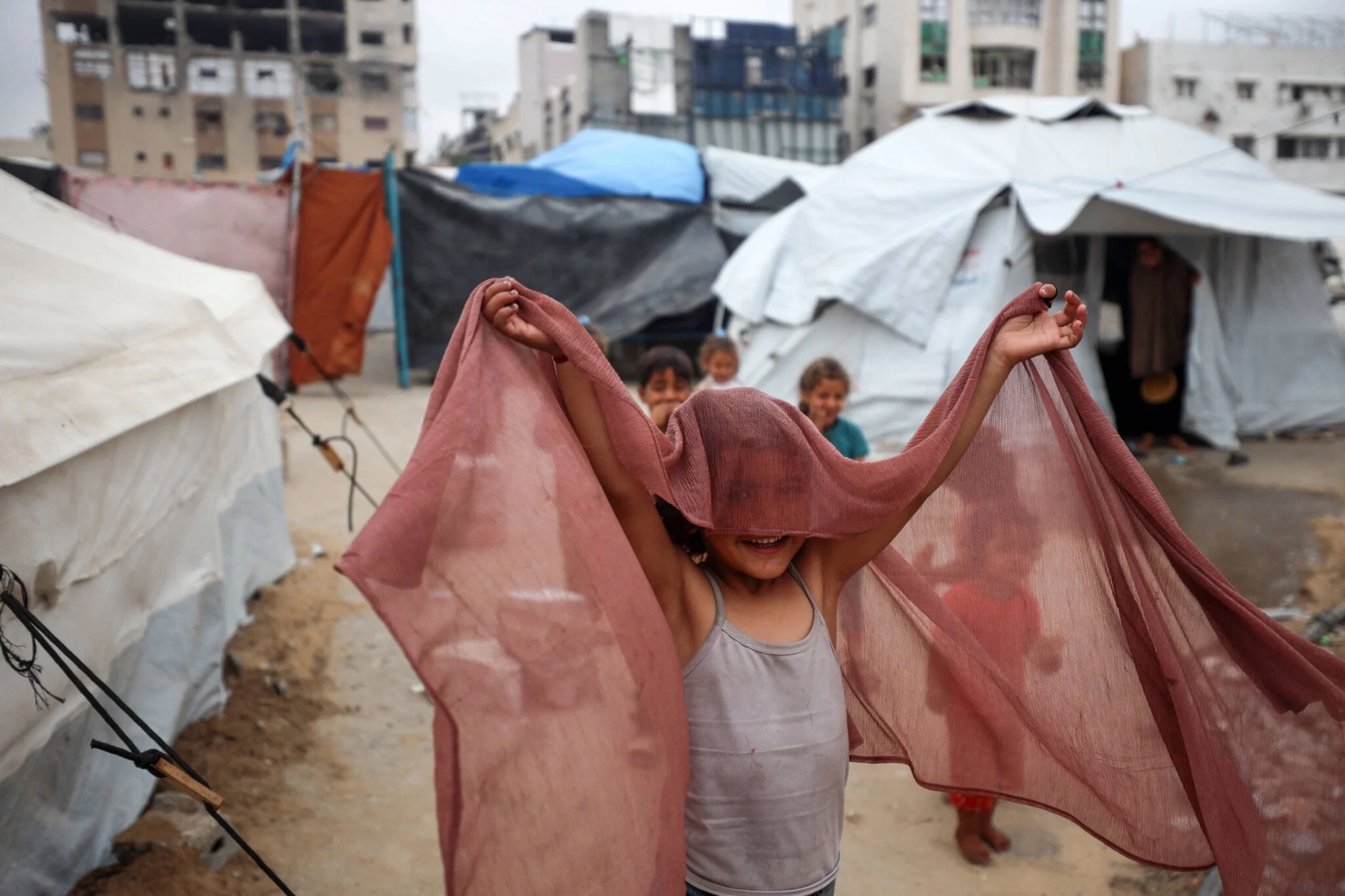
The war has obliterated over 90% of Gaza’s residential infrastructure. This destruction has forced over one million people into a rental crisis never seen before. Tens of thousands of families who lost their homes and could no longer bear to continue living in tents have been forced to rent whatever they can find: apartments, single rooms, partially damaged homes, rooftops and storage spaces unfit for living. This shortage has driven rents to unprecedented heights and produced what is now described locally as a new rental economy. As habitable housing has become scarce and commodified, securing shelter now rivals the challenge of securing employment.
Under this new system, households allocate the majority of their income—or the aid they receive—towards rent. Before the war, when the average income was closer to $600 a month, families spent at most $200 on rent. Today, the average rent sits closer to $800 while the typical household income has plummeted to $300. The war has thus not only changed Gaza’s urban landscape; it has fundamentally shifted how people live, and ultimately, how they relate to one another.
For Madi, the hope of one day rebuilding their home, of an end to this perpetual insecurity, has been all but lost. “When the war on Gaza ended in October 2025, we felt a measure of hope for reconstruction to begin,” Madi says. “But with the outbreak of the American-Israeli war on Iran, Gaza was pushed off the table, and that hope faded.”
Gaza’s rental market has been completely reshaped by the war. Prices have surged to unprecedented levels driven by widespread destruction and intense demand for the limited number of apartments still fit for habitation.
Yousef al-Badrasawi, a real estate broker in Gaza City, told me that before the war, a mid-size apartment might rent for, at most, $200. “Now, everything has changed,” he explains. That same apartment rents for at least $700 and, in some areas, much more. These surges extend even to the small rooms long rented out across Gaza. Where a studio for one might’ve cost $50, its price now ranges between $300 and $400 dollars, particularly in places that haven’t been as heavily damaged. These surges, al-Badrasawi explained, reflect the population’s desperate desire for housing. “People are willing to live in such tiny rooms because they refuse to return to living in tents.”
Cash payments compound these pressures. Most landlords now demand to be paid in bills, despite the liquidity crisis that continues to plague the Strip. Most Gazans rely on transfers or electronic payments, and such a demand puts them into an increasingly vulnerable position.
The result is an imbalance of power between landlord and tenant that is entirely new in Gaza. Evictions are rampant, and competition for housing continues to drive people back out onto the streets. “Even those who pay on time are replaced if another tenant offers more. The market is now governed solely by supply and demand, with no other considerations,” al-Badrasawi says. Never before have prices been so high and, critically, never before has a family had to spend all their earnings to ensure they remain sheltered.
“This is not normal.”
In an apartment no larger than 120 square meters in Gaza City, Abdullah Mteir lives with his wife and three children. They are not alone. The home is shared with two other families—eleven people in total. They share the rooms, the kitchen, the bathroom, and above all else, the exorbitant rent.
Mteir says this arrangement is the only way. Unable to afford separate apartments, the families chose to split the rent despite the strain of living together. “Sometimes it feels like a shelter, not a home. There’s no privacy. The children are everywhere, and conflicts happen, but what can we do? It’s better than the street or a tent.”
When Mteir first rented the apartment last October, the monthly rent was 1,500 shekels, around $500. The price, already high relative to the rentals they were accustomed to before the war, was still manageable when split between multiple families. But as the housing crisis deepened and demand grew, the landlord raised their rent more than four times in a couple of months. The families are now expected to pay 2,500 shekels or about $800 combined.
The justification was again the same. “There are others willing to pay more,” Mteir says. “If we don’t agree with the increase, he tells us that we can leave. We know he could rent the apartment within a day, so we have no choice.”
Conversely, as rental prices surge across Gaza, Mteir’s income has all but collapsed. Before the war, he worked as a construction contractor, but with building projects halted and Israel continuing to restrict the entry of construction materials into Gaza, he lost his job. He now relies on sporadic, temporary work and earns, at most, 1,000 shekels a month (about $300).
From the inside of their living-room-turned-bedroom, it’s evident how this rental crisis has gradually exhausted the family. They siphoned all their savings first and when that ran out, they turned to his wife’s jewelry. Again, that was insufficient. They’ve since sold what little furniture filled the apartment. They began with the bedframe, then the couch, and then the dining table.
Now, when the rent comes due, the families, like clockwork, come together to negotiate their survival. They begin, always, with the same question: Who has money? Then: Who can borrow any? Before, finally, agreeing to what pieces of furniture would be sold.
“It’s as though we have to sell our home piece-by-piece just to remain in it,” Mteir’s voice dulls to a whisper. “Sometimes, it’s as though I’m not living for my family. I’m living just to pay rent. All of our pain and exhaustion across each month ends up going towards the rent. And then we return to zero again.”
Mahmoud Abu al-Abd never imagined he’d be forced to one day split the apartment he had spent years building. He’d never imagined he’d divide the space, barely 140 meters, in half: one side to rent a section to a family and another to live in. But the war, as is said, changed everything.
After the war robbed Abu al-Abd of his only source of income as a foreman, he built a wooden divider in the middle of the apartment, fashioning two semi-separate entrances and renting it out. The space is no more than 70 meters and Abu al-Abd charges the family upwards of $700 to the family who stays there.
“Before the war, I never thought about rent or renting,” he shares. “But once I lost my job and prices soared, we no longer had enough income to survive. I started thinking about how I could make use of the apartment itself.” The division itself is rudimentary, a wooden slab and some sealed-off doors. Though they don’t share the kitchen or the bathroom, Abu al-Abd says the living quarters are still cramped. “Still, it’s better than having no income at all.” It’s the only thing, Abu al-Abd says, that allows his family to live “an acceptable life.”
He’s now thinking of renting out the uncovered roof of his home in order to increase their cash-flow. For a monthly fee, they’d be able to set up a tent or makeshift room above the apartment. “It may sound strange,” Abu al-Abd said, “but in Gaza today, every meter can be turned into a source of income.”
This is Gaza’s current reality. Every square meter of land is a potential source of income. Rooftops and even vacant agricultural sites are being repurposed as rental spaces. Families live in these small plots—often abandoned farmland—to avoid the overcrowding of shelters and typical tent lots. In those fields, rent is charged by the square-meter, at roughly $2 per unit.
“Sometimes I feel sad because I no longer live in my home the way I used to,” Abu al-Abd tells me. “We’ve started measuring our movements inside the apartment so we don’t disturb the tenant, and there’s less privacy. But we were forced into this. Today, people don’t rent out their homes because they have extra space; they rent out parts of their homes just to survive.”
Though the rising rents in Gaza may resemble those of a typical city desecrated by war, this crisis is inherently more severe. There are structural consequences, economic expert Ahmed Abu Qamar argues, that have compounded the effect.
“In most wars and disasters, the destruction of housing reduces supply and drives up demand, which in turn raises rents,” he explains. “But Gaza is different. The scale of destruction is enormous, there are no clear prospects for reconstruction, and people have lost the majority of their sources of income. This is a housing crisis far more severe than a simple surge in price.”
When asked if the situation was exploitative, Abu Qamar was ambivalent. “Yes, in some cases there is clear exploitation of the crisis, when rents are raised repeatedly over a short period or when tenants are evicted simply because someone else is willing to pay more. But at the same time, some landlords have also lost their livelihoods and now depend on rent for income. So the picture isn’t entirely black and white. It reflects what is, in every sense of the word, a crisis economy.”
The absence of a regulatory body has also deepened the problem. Abu Qamar described the need for economic and social intervention—policies, whether from government bodies, municipalities, or some other institution, to cap rents or regulate the relationship between landlords and tenants. “Housing is not an ordinary commodity; it is a fundamental need. Leaving it fully exposed to market forces during a humanitarian catastrophe risks severe social consequences.”
The depth of this crisis is tied entirely to Israel’s ongoing blockade on reconstruction. The calculation is simple: as the number of habitable homes stalls, the population in Gaza will continue to increase. Tens of thousands of homes need to be built. Otherwise rent prices will not change.
This new rental economy will continue for years, Abu Qamar predicts. “We may see new forms of adaptive housing emerge in the future: subdivided homes, vertical constructions, the renting out of rooftops and land.”
As larger and larger shares of household income are consumed by rent, spending on education, healthcare, and food will inevitably decrease. Debt will surge as families continually sell off what remains of their assets. A destitute Gaza will be plunged into an economic crisis now driven principally by a housing shortage.
This crisis has created deep social and psychological scars in the population. This is evident already in the widespread delays of marriage in Gaza. As young men and women are unable to secure suitable housing, the formation of new families continues to be postponed.
Even when housing is secured, it typically includes multiple families confined to a single quarter. Here, the issue is only exacerbated. Dardah al-Shaer, a professor of social psychology at Gaza University, sees this manifest in the everyday. “Conflicts sometimes escalate into arguments or threats of eviction, which increase psychological pressure on families. The feeling of insecurity in the place where they live creates constant tension.”
As privacy is foreclosed, relationships between spouses and children continually erode. “Children no longer have space to play or study, and parents struggle to maintain any sense of daily routine,” al-Shaer said.
But there remains no other choice. The hell of living in tents invites physical risk: the threat of weather and the absence of basic services like water and electricity. But the toll of displacement remains inescapable, felt across Gaza, among every member of a family housed in a tent or an apartment. A life reduced to a false dilemma.
Rasha Abou Jalal is a journalist living and writing in Gaza.
This piece appears in the twenty-first issue of The New York War Crimes.