

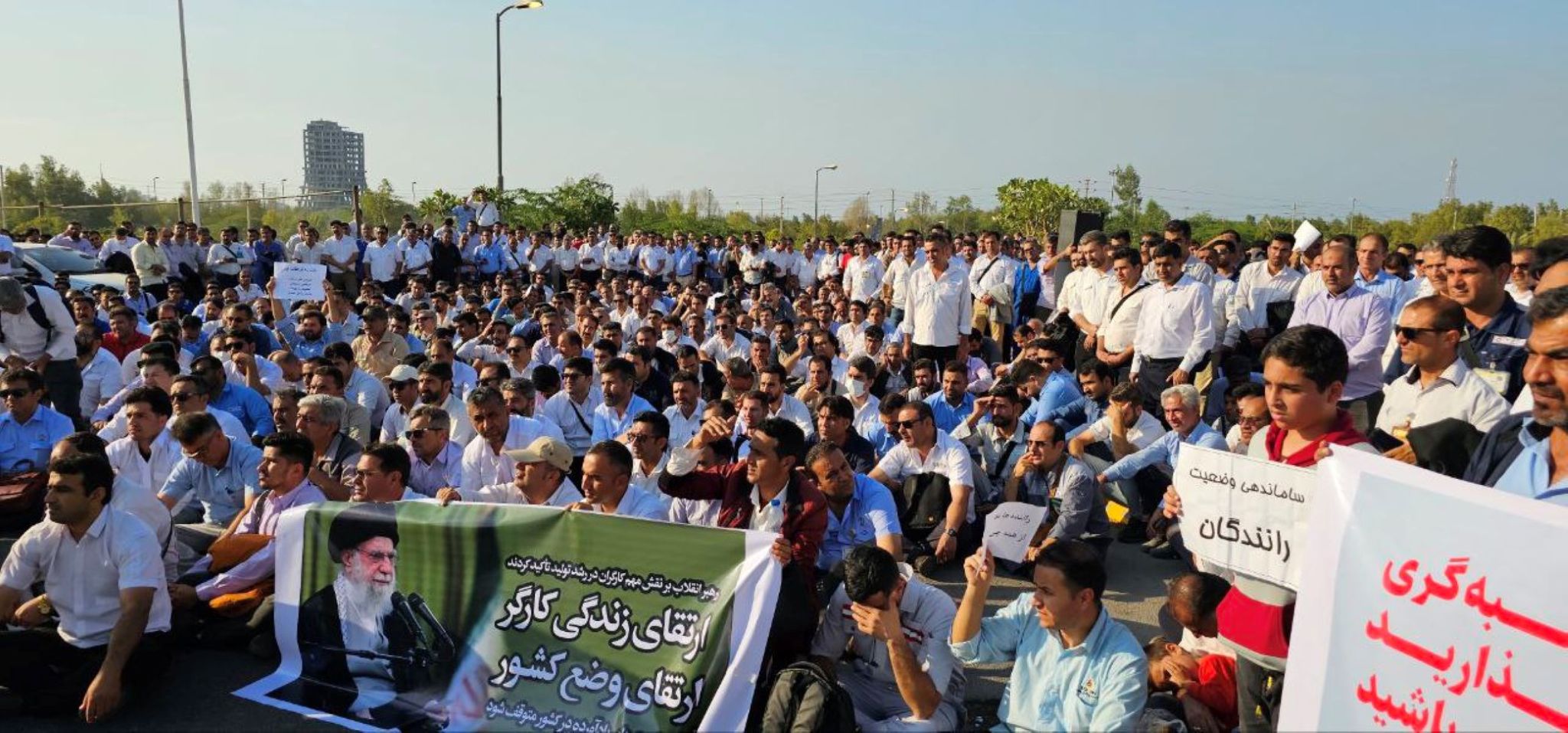
For the twenty-third edition of The New York War Crimes, Helyeh Doutaghi talked Iranian organizers, Alireza Mirghaffari and Mohammad Sadegh Shahbazi, whose politics are explicitly grounded in social justice, national sovereignty, and resistance to imperialist intervention from within the institutions, social movements, and political traditions of the Islamic Republic.
The imperialist media and state apparatuses that shape political discourse in the United States have, for decades, normalized narratives about Iran that often reduce it to an object of Western intervention rather than recognizing Iranians as political agents with their own histories, institutions, and contradictions. The Iranians most readily platformed in English-language media are frequently those who affirm the geopolitical premises of U.S. foreign policy. Millions of Iranians whose political commitments do not conform to those narratives are however routinely rendered invisible, caricatured as irrational fanatics, or simply dismissed as“regime supporters.” This erasure has material consequences. When Iranians are discussed through the language of “annihilation,” “destroying civilization,” or collective punishment, the systematic dehumanization of Iranian political subjects makes such violence easier to imagine, justify, and normalize. It is therefore essential to create space for Iranian voices that are rarely heard in the West, not because they represent a single or uniform Iranian position, but because they illuminate political traditions, struggles, and forms of organization that are routinely excluded.
Alireza Mirghaffari is the president of the Association of the South Pars Gas Refineries Workers’ Unions of Bushehr Province. The group represents approximately 15,000 contract workers in 12 refineries of South Pars, home to Iran’s most strategically important gas fields and one of the largest gas reserves in the world,which was directly targeted by the U.S.-Zionist forces during the recent war of aggression against Iran. Mirghaffari and his fellow organizers have built and consolidated one of the most significant independent labor formations in post-revolutionary Iran, mobilizing against economic policies that deepen precarity and exploitation through sustained workplace organizing, legal struggle, and collective action. The union has secured important gains for workers while consistently challenging economic policies that deepen precarity and exploitation. Most recently, it organized one of the largest labor mobilizations since 1979, bringing over 5,000 workers into the streets. Mirghaffari represents a distinctly Iranian form of anti-imperialist labor organizing: one that understands workers’ rights, social reproduction, national sovereignty, and resistance to foreign intervention as interconnected.
My second guest is Mohammad Sadegh Shahbazi, a political organizer and activist whose political formation began during his student years at the University of Tehran, where he became involved in organized movements centered on social justice and subsequently served in leadership within the student movement. He has participated directly in Iran's electoral politics, including running for parliament, while also developing sustained critiques of Western-oriented political projects and their domestic and foreign-policy orientations. His work has included organizing and political advocacy around social justice, national sovereignty, and an explicitly anti-imperialist foreign policy, as well as writing on the political thought and doctrines of the Islamic Republic, Ayatollah Khomeini and Ayatollah Khamenei. His perspective is therefore significant because it emerges from within an Iranian political tradition that is frequently discussed from outside while rarely allowed to articulate itself on its own terms.
These are precisely the Iranians who are often erased from English-language coverage. Their exclusion is not incidental: Dominant representations of Iran privilege rhetoric that can easily be incorporated into familiar Western narratives of liberalization or regime change, while treating other forms of Iranian political agency as illegitimate and irrational before they are even heard. Mirghaffari and Shahbazi are not detached observers of the Iranian or its politics; they are active participants in political, social, and class struggles that have unfolded within it. They have spent years building institutions, mobilizing workers and students, contesting economic policy, negotiating and challenging state structures, and defending what they understand as the unfinished social and political commitments of the 1979 Revolution.
We must, therefore, approach them as Iranian political actors with their own commitments, disagreements, and conceptions of sovereignty and emancipation. Their voices do not exhaust the diversity of Iranian political life, nor should they be treated as speaking for all Iranians. Their significance lies elsewhere: They offer access to political traditions and forms of organization that are routinely excluded from Western discourse about Iran. At a moment when Iranian society has endured war, sanctions, foreign intervention, and profound internal political tensions, listening to those who have organized within the country — and who view anti-imperialism as a condition shaping the lives of every day Iranians — is indispensable to any serious understanding of Iran.
Alireza Mirghaffari
On the impact of war on organizing efforts and labor struggle in South Pars:
On 18 Azar (December 9), roughly three months before the beginning of the war and one month before the attempted coup against Iran in January, we organized the largest labor gathering in post-revolutionary Iran in Asaluyeh. We organized it on behalf of approximately 15,000 workers, and between 5,000 and 6,000 workers came into the streets. That mobilization demonstrated the considerable capacity of organized labor in Iran to advance workplace-based demands through collective action.
After the outbreak of war, however, and given the events of recent months, organizing has become more complicated. Under these circumstances, our immediate priority has been the preservation of Iran’s territorial integrity, sovereignty, independence, and security, while continuing to pursue workers’ demands within that framework. We see the defense of Iranian sovereignty as the precondition of workers’ rights and advancing their struggles.
Workers who, before the war, had been organizing regular strikes and demonstrations across different refineries temporarily suspended their protest activity after the war began. Many instead volunteered for additional shifts and increased their presence at work so that damaged production units could be restored and returned to operation as quickly as possible. South Pars and its energy infrastructure were directly targeted. For us it was clear that restoring productive capacity was not simply an economic task. It was part of the social, national, religious, and political responsibility of the working class. This became particularly important following attacks on infrastructure and the assassination of officials and specialists.
At the same time, access to officials and authorities at higher levels responsible for addressing workers’ demands has become more difficult than before. We therefore face two simultaneous realities: the urgent necessity of rebuilding damaged refineries and restoring production, and a political and security environment that has made the pursuit of workers’ demands more complicated.
We are currently deeply involved in the reconstruction of the refineries, while Iran remains under extensive U.S. sanctions and blockade, which have made the reconstruction process more difficult and forced us to rely heavily on domestic technical and industrial capacity.
Under these conditions, we do not believe that worker organization can be defined simply as workplace protest. Genuine organization means that workers must be capable of recognizing the historical priorities confronting them, maintaining organizational cohesion, defending their class interests, and at the same time protecting the productive infrastructure of the society that workers themselves produce and reproduce.
On international solidarity with Iranian workers:
When we speak about meaningful solidarity, I think we first have to recognize a fundamental reality: Workers in the imperial core live within an economic structure in which a significant part of their material position and purchasing power is, at a structural level, connected to unequal relations between the center and periphery. This does not erase the common interests of workers across the globe, but it does mean that we have to take seriously the different material and historical positions from which workers enter the global class struggle.
That also does not mean that workers in the U.S. are powerless or without responsibility. On the contrary, they possess considerable power to impose costs on their government and employers. But exercising that power requires political and historical consciousness about the role their labor can play within the imperialist system.
We saw some examples of this during the genocide in Gaza. Workers and trade unions in the United States (as well as others in Europe), including workers involved in logistics and other parts of the supply chain, have challenged shipments connected to Israel and attempted to disrupt their own participation in the U.S.-Zionist machinery of death. These actions demonstrate that workers in the West are not merely passive victims of their governments’ foreign policies. They have the capacity to intervene at the point of production and within the supply chains through which war is materially organized.
We have not yet seen the same level of action in relation to Iran. The first step is therefore education. Western unions and workers need to understand the history of their governments’ aggression against Iran’s sovereignty and self-determination: from the 1953 coup against Mohammad Mosaddegh following the nationalization of Iranian oil, to Western support for Iraq during its war against Iran, to decades of sanctions, assassination, sabotage, and more recent military attacks and interventions against Iranian sovereignty.
That historical understanding should lead to a practical political position. Workers in the United States should continue fighting for fair wages, job security, and safe working conditions. But they should also ask whether their labor is directly or indirectly contributing to the production, transportation, or provision of the means through which workers in other countries, including Iran, are being attacked.
For us, this is not an abstract question. South Pars, where I work, has itself been targeted. The weapons used in attacks against our infrastructure are produced through military industries and supply chains in Western countries. So when an American worker produces military equipment, or works within a logistics system that transports it, the question cannot be reduced to that worker’s own wages, safety, or job security. There is also a question of what that labor produces in the world beyond the workplace. Workers must ask how their labor, their company, its technologies, and its logistical infrastructure are incorporated into the global political economy, and whether that system contributes to the killing of workers and civilians in countries such as Iran.
Meaningful solidarity begins when workers in the imperial core recognize that their security and prosperity cannot be built at the expense of insecurity and death for workers in the global periphery.
Solidarity with Iranian workers therefore cannot mean speaking on our behalf, appropriating our demands, or transforming our struggles into instruments of political pressure against the Iranian government. It is our responsibility to critique and hold to account our government. Solidarity means for the workers to understand their government’s role in our disempowering and death. It means understanding the history of intervention, opposing sanctions and war, and using the organized power of labor to impose costs on the institutions and employers that participate in these systems of violence.
If an Iranian worker is standing in the face of war to preserve their refinery or factory, their family, and their society, then solidarity from an American worker should begin with ensuring that their own labor is not being used to destroy that refinery, kill that worker, or make that family’s life more precarious.
On workers, everyday life, and the meaning of victory in the war:
In this war of aggression, the United States has failed to achieve its stated objectives of intervening in Iran’s internal political order, dismantling its sovereignty, “changing its map,” as Trump claimed, or looting its national wealth and strategic resources, including oil and gas. Iran, by contrast, has successfully defended its territorial integrity and sovereignty, while making significant advances in decolonizing West Asia — effectively rendering key U.S. bases inoperable in the Persian Gulf and asserting sovereignty, for the first time ever, over one of the world’s most critical corridors for the movement of energy and capital.
This does not mean that the United States has ceased its efforts to create the conditions for political destabilization, including through economic warfare, heightened volatility, and the persistent threat of all-out war and continued acts of aggression, all of which impose immense material and psychological costs on ordinary people. The Iranian people have endured enormous pressure and paid a considerable price. Yet the Iranian Revolution of 1979 was a collective political project through which Iranians decided that they will not live under imperial subjugation; the history of colonial and imperial domination, as well as recent examples of U.S. intervention in countries such as Syria and Libya, demonstrates that the collapse of national sovereignty and security can produce conditions that are vastly more destructive.
It is also important to note that, despite the economic pressure produced by war, decades of U.S. sanctions, and more recently the U.S. naval blockade, the basic systems of production and provision have not collapsed. Prices have risen and people face significant economic pressure, but there has been no generalized shortage of essential goods or complete breakdown in access to food and other necessities. For us, the continued production and provision of essential goods is itself part of what a resistance economy means.
Iranian society is politically and ideologically diverse. There are serious critics of the government, people who oppose the state entirely, millions who support the Islamic Republic, and others who have volunteered to defend the country or taken to the streets in support of its armed forces. The experience of war—and the direct targeting of civilians, schools, hospitals, and productive infrastructure—has nevertheless made one reality more tangible across these political differences: without sovereignty and security, it becomes exceedingly difficult to pursue sustained internal reform, advance social justice, or achieve meaningful social and economic progress.
On maintaining independence amidst the threat of foreign intervention:
The constant military, economic and political interference and aggression against Iranian sovereignty by the U.S. and its allies, also makes it more difficult to distinguish between an independent labor or social protest and a political project aimed at destabilization or regime change. When a country is confronting foreign intervention, coup attempts, or organized efforts at destabilization, security and political institutions may become more suspicious even of genuinely independent labor, women’s, and student movements. The boundary between an independent labor demand and a movement that external actors attempt to appropriate therefore becomes more difficult for everyone to navigate.
This is fundamentally different from conditions in the imperial core. There, labor, women’s, and economic demands are generally not treated as potential instruments of an external power seeking to transform the country’s political order. In Iran, because of the long history of imperial intervention and external pressure, even legitimate social protests can become vulnerable to external appropriation.
That is precisely why we insist on the independence of the labor movement. A labor protest must emerge from workers themselves, from their material needs and collective experience, without mediation by foreign powers. Defending the independence of our demands is therefore inseparable from defending the independence of the labor movement itself.
Mohammad Sadegh Shahbazi
Do people think they won the war? What does that look like in everyday life in Iran right now? What does victory feel or look like?
The absolute majority of the Iranian people believe in victory. Not only did they remain standing in an asymmetric battle against two nuclear powers and the world's foremost superpower, and defeat the enemy's objectives, but they also inflicted real pain on the enemy: roughly twenty American bases across 10 countries were targeted, the aura of the world's foremost superpower was shattered, and the prices of oil, gasoline, jet fuel, sulfur, aluminum, helium, and more were brought under control. Above all, America — like Britain after the Suez Crisis — was reduced to a former superpower. Rather, the country was revived; the people have been in the streets every night for over 210 nights. Above all, Iran was victorious in the moral battle. It retreated from no principle, standing against the child-killers of Epstein Island who perpetrated atrocities like Minab and killed children. The self-proclaimed defenders of women's rights in Lamerd turned the stadium of Iran's female volleyball players into blood and dust. You will not find any country where all its leaders have been targeted and the people defend the country and even call on their officials to stand firm. In all countries, under wartime conditions, officials worry about the people's resilience; in Iran, the people worry that some officials might show weakness. Despite inflation and the natural problems produced by war, the Iranian people are more resilient than some of its officials. Most police stations, barracks, and Basij bases have been targeted, and Tehran has faced no security threat in these two hundred days. Polls show that over 80% of the people believe in standing against the West and in victory. Iranian society, instead of fearing American threats, is living a normal life. Every night that Iran targets the US in the Strait of Hormuz, Jordan, and the Persian Gulf countries, popular gatherings become more passionate in streets. Many people, despite different political, ethnic, religious, and other differences, have installed the flag of Iran and the flag of revenge on their homes and cars. Iranian polls show that nearly 70%of the people have participated in these nightly gatherings, and many who have not come also support standing firm. The war turned Iranian society back into a united nation; the Iranian dream was revived. This is not merely the “gathering around the flag”, nor is it merely Hegel's spirit of the age — it is the rebirth of the spirit of the 1979 Islamic Revolution. A people who have once again joined the spirit of the revolution, and even many of those who had criticisms of the system now believe in Khamenei's ideas in what US imperialist arrogance is and does to a nation seeking and asserting its sovereignty.
What is the cost of this war, and who pays this cost?
Naturally, war has costs. The people and the government in Iran have paid various costs: the martyrdom of the people, the children of Minab, the girls of Lamerd, the sailors of the Dena destroyer, the families of the Sunni community of Sirik, Iranian defense forces, officials, Ayatollah Ali Khamenei and others. No sane person seeks war, but no honorable and sane human being accepts humiliation either. The United States seeks to enslave Iranians. Iranian officials, despite the opposition of many people, even pursued negotiations, and the country experienced that three rounds of negotiations with America resulted in three wars: the 12-day war, the 39-day war, and the 13-day war (the Hormuz battle). In the negotiations that led to the 39-day war, Iran even placed very great concessions on the table that under normal conditions it would have been impossible to give, but the United States was satisfied with nothing less than complete surrender. Here is precisely what Churchill said about Nazi Germany: “when you have your head in a tiger's mouth, you do not negotiate with it.”
Opposing war is good, but on the condition that we take justice into account. It matters who is the oppressor and who is the oppressed. The resistance of the oppressed against the oppressor, and of the one who has been aggressed against the aggressor, is a reasonable and human matter.
Iranians did not start a war and even tried to remove the shadow of war through negotiation, but the whole world saw that the government of the United States and Israel are not only warmongers but treaty-breakers, and observe no human or moral principles.
The Iranian nation is aware of the costs of war, but through the experience of its own history and the history of other nations, it has learned that the cost of compromise and surrender is far greater than the cost of resistance. The Iranian nation knows that if it does not stand today, it will suffer the fate of Iraq, Syria, Libya, Sudan, Somalia, Venezuela and others.
But the Iranian nation is not in a position of weakness; by standing, they have gained dignity. They inflicted pain on the Epstein coalition by controlling the Strait of Hormuz; they rose above the level of a regional power.
This is not a war that the leaders of a country started for their own interests of wealth accumulation, unlike the US. The people and officials of Iran fought side by side to preserve their identity, their land, and their control over their own destiny. Even when the country's political and military leaders and the Supreme Leader of the country were martyred, and even when officials advised the people to leave Tehran to save their lives, the people did not leave, and for the first ten days of the imposed war without a Leader, they stood and took control of their own destiny. Since the selection of the new Leader, they have remained on the scene for two hundred days.
This is both a national ideal and a religious duty. Muslims are obligated to preserve their dignity and stand against aggressors, and God has promised that if this happens, final victory will certainly be theirs. A Muslim is obligated to stand not only against any aggression against himself but against any other oppression in the world. The Prophet Mohammad called anyone who hears the cry for help of an oppressed person and does not rush to his aid a non-Muslim.
Of course, questions or morality and dignity do not occur to the leadership of the United States: the American people and soldiers are expended so that Wall Street gangs, weapons and fighter-jet manufacturing companies like Lockheed Martin and others can profit— with their taxes, the war machine of the occupying regime is fed. For them, war is an adventure for the rich so they can secure the gangs of power, wealth, and information.
How do western leftists liberationists anti-imperialists (people in the heart of empire) meaningfully forge alliance with Iranian people, who are living under war conditions right now?
First, they must recognize what the US corporate media has done to their understanding of countries that are considered the enemy of the US because they resist its domination; and take serious steps to unlearn those.
Second, they should never approach the Iranian people from a position of presumed moral or intellectual superiority. It is now, for the world to see, what our nation recognized four decades ago: that the United States and the Zionist entity are among the gravest violators of human rights, particularly in light of the ongoing, livestreamed genocide. They should engage with the Iranian nation as an equal who objects to oppression. We need a global anti-arrogance front that takes real action not performative solidarity with statements and signatures.
Third, they should effectively protest (that is to impose cost) the crimes of the United States against the Iranian nation.
Fourth, they should refuse to welcome war criminals responsible for grave violations of international law in their cities; despite assurances from the New York mayor, we once again saw Netanyahu welcomed in New York City.
Fifth, they should make the centers of power, wealth, and information that support Israel and supply it with weapons, money, energy, and food the target of their actions/BDS.
Sixth, they should make the interests of the centers of power, wealth, and information the target of their actions/BDS.
Finally, and perhaps most importantly: They should not underestimate the conditions and sacrifices that genuine solidarity may require. In times of severe repression, standing in solidarity can carry real personal consequences: people may risk their immigration status, employment, social standing, or even become targets of doxxing and threats. We have seen brave individuals, over the past two years, across the West willing to take such risks; meaningful solidarity requires recognizing that, in time of active genocide and fascist repression, solidarity may come at a significant cost. To stand with people may require accepting consequences and making sacrifices. That willingness to bear a cost is, at times, precisely what genuine solidarity demands.
The fact that anti-war activists, leftists, and anti-imperialist forces from Vietnam until today, despite great efforts, have not been able to prevent wars such as those in Iraq, Afghanistan, Gaza, Lebanon, Yemen, and Iran shows that the ideology and strategy of struggle need to be revised. We have experiences in Iran that we are prepared to make available to justice-seekers around the world.
Your thoughts about the recent letter by a number of Western leftists, expressing solidarity with “Iranian prisoners”
Those who seek to advocate for human rights, justice, and freedom bear a particular responsibility to approach the societies they defend or critique with intellectual caution, analytical rigor, and humility. This requires not only a serious effort to understand a society’s historical, political, and social context, but also a conscious resistance to informational echo chambers—the tendency to privilege and ultimately accept only those accounts that confirm one’s pre-existing assumption (including from Iranian diaspora who celebrated the bombing of their own homeland). Without such discipline, even positions motivated by legitimate concern for human rights can become vulnerable to serious miscalculation. This is particularly important in the case of Iran, a society targeted by exceptionally intense imperial warfare for decades by the United States. Genuine solidarity therefore, especially by those situated in the US, requires intellectual independence, analytical rigor, and the courage to question even the narratives that align with one’s own political convictions. The recent letter, rather than expressing any meaningful solidarity with Iranians (which from people based in the US means opposing US imperial warfare in all its forms), reproduced an imperial logic in which Iranian people are to be “saved” from their own government, even as the U.S. government bombs those very prisons. Solidarity that reproduces the political logic used to legitimize external intervention risks ceasing to be solidarity with a people and instead becoming an extension of the very narrative through which power legitimizes its own intervention.
This piece appears in the twenty-third issue of The New York War Crimes.