

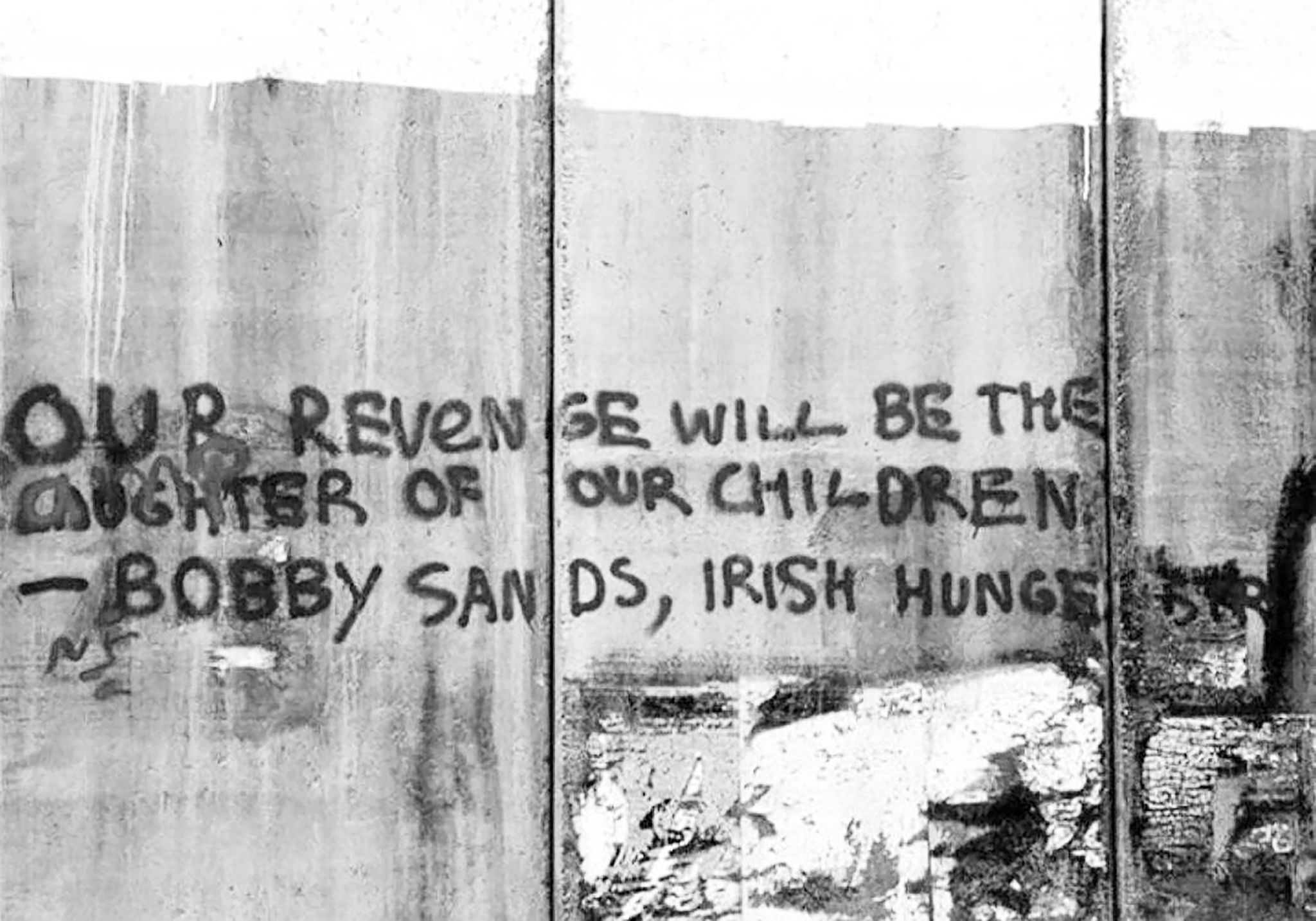
Across struggles for freedom and liberation, hunger strikes have been used to transform the body into a front of battle — from Long Kesh in Ireland that held Bobby Sands to Soledad Prison in California that held George Jackson. In Palestine, hunger strikes also belong to a long history of embodied resistance, where the human body is employed as a weapon in pursuit of political gains. Hunger strikes are life-affirming and life-sustaining for both the individual prisoner and the Palestinian national struggle.
There have been dozens of hunger strikes throughout Palestinian history that have been used to win critical gains for Palestinian prisoners and leaders behind bars, while drawing attention to the prisoner’s struggle in moments when Zionist forces attempt to isolate the prisoner’s movement. From the historic strike of 1992, which forced the lengthening of family visits, improved medical care, and permitted study and organizing behind bars, to the Karma (Dignity) strike of 2012, which ended long-term solitary confinement for several prisoners, hunger strikes ignite collective consciousness and build national unity.
Through hunger strikes, Palestinian prisoners exemplify national leadership from behind bars, using their stomachs to launch a confrontation with the occupier — a confrontation that has historically extended beyond prison walls and moved Palestinians, and people around the world, into action.
The following is an edited transcript of a conversation between Loay Odeh, Heba Muraisi, and Jeanine Hourani discussing the significance of hunger strikes as a collective tactic, the generative relationship between the movement inside and outside of prison, and the connections between the unique experience of Palestinian prisoners and the Filton 24 in Britain. Loay is a liberated Palestinian political prisoner from Jerusalem who was first imprisoned at age nine, spending a total of 12 years behind bars. He currently lives in Belgium and organizes with Beitna. Heba is a Yemeni British organizer and a member of the Filton 24 who spent 15 months in British prison. Jeanine is an organizer with the Palestinian Youth Movement.
Jeanine Hourani: Loay, tell us what you learned about hunger strikes during your formative years in Zionist prison.
Loay Odeh: The hunger strike is the tactic of last resort. In the history of the Palestinian captive movement, you use every tactic available before you resort to using the body, the last weapon, as a means of struggle.
When we talk about the Palestinian prisoners movement, we are talking about thousands who are on hunger strike at the same time. There are far graver dangers to the lives of the hunger strikers, uncertainties that are hard to predict, such as unexpected illnesses. You also have to factor in how the Israelis will react to the hunger strike and the consequences that the captives will face. With every strike, the prison administration develops new responses. I believe there are no comparisons to these concerns in Britain. The Israelis are professionals in such matters.
The hunger strike requires at least a year of planning. Everyone participates in compiling the demands, no matter how silly or seemingly insignificant such demands are. Every participant in the hunger strike must acquire a stake in the process of shaping the demands.
When collecting the demands, the list would grow and grow with each contribution. Everyone listed what they wanted. Someone once requested a bicycle and added it to the list of demands. Then, a core list of ten demands is chosen, and the rest become secondary demands. Why? This empowers the captives themselves to feel a stake in the strike, to feel they have participated and made active decisions. But the first and most important demand was always centered on our comrades in solitary confinement.
Then there are the communiques that outline the potential health risks, providing guidelines on what to do the first few days and few weeks, leading up to the more challenging periods. Psychological mobilization is also addressed, reinforcing the importance of the struggle and the necessity of persevering and adhering to the directives of the leadership of the strike and their negotiation strategy. There are four layers of leadership for each strike, following a nested strategy that allows for continuity.
Preparation is the most vital task. If we enter a hunger strike without due preparation or a sense of cohesion, the strike can be broken in the first few days. It only takes a few captives to give up for the collective spirit to deteriorate.
The hunger strike is the single most important tactic for improving conditions inside Zionist prisons. At the beginning [in the early ‘60s], the conditions were as they are now. Blatant oppression, gratuitous torture, and death. Hunger strikes achieved progressive wins, like rights to television, then to self-rule inside of prison, then to official representation of political parties in the “internal order,” which allowed us to continue organizing in factions. They take what we’ve achieved, and we reclaim it.
Another factor in the success of a hunger strike is [popular support]. The challenge and the endurance of our families and people outside of prison was the single most strategic rallying point behind our victory.
Heba, how did members of the Filton 24 decide to take up a hunger strike? How did you all agree on the five demands?
Heba Muraisi: It was also a kind of last resort. We had been imprisoned for nearly a year. The demands were very difficult to narrow down. It took some time, especially because we were also isolated from each other. Even though I was in the same prison as, for example, Qesser, Amu, and John, I hardly ever saw them. We actually had our own language. We would write to each other with this language and try to get other prisoners to pass the message.
We were thinking about doing a hunger strike for a while before we reached a consensus. I think the decisive moment came when me and two other activists were forcibly shipped out. It affirmed our decision and ignited everything that we were feeling inside. Less than four weeks after I got shipped out, my hunger strike began. For us, it was not only a form of resistance to state repression, but it was also about rejecting the institutional framework.
There is some overlap between the prison system in Britain and the Israeli prison system. For example, administrative detention — meaning that prisoners can be held without charge or trial — was initially introduced in Palestine under the British mandate. Similarly, the Filton 24 were being held on remand without charge or trial. But there are also differences. Loay, can you discuss what sets the Palestinian hunger strike apart from those in other contexts?
Loay Odeh: The Zionist movement inherited the prison system from the British in quite literal terms. They didn’t just adapt the system, meaning the torture and the mistreatment, they took the buildings themselves. All the prisons that I’ve entered in Israel are, in architectural terms, British prisons. When I visited Dublin, I visited some of the prisons there and found that they were identical [to Israeli prisons in Palestine]. I saw the same architectural and building style, the same watchtowers, the same types of rooms to hold people in captivity. The Zionists also inherited the British Mandate legal codes that govern prisons. In drawing on their British predecessors, they strive to legitimize and legalize their oppression through historic precedent.
I think there are big differences between incarceration in Britain today and the Palestinian prisoners movement, which is more accurately compared to the Irish movement. What properly distinguishes the Palestinian captives movement from other movements for national liberation that involve incarceration is the extensive Palestinian internal organization within prison. The “internal order” was initially set up in 1964, and it has developed and persists till today.
Every Palestinian captive who enters Israeli prisons becomes part of this “internal order,” which governs all aspects of life […] from brushing your teeth in the morning, to how to engage in a hunger strike, to who represents and speaks on behalf of the captives, and everything in between.
There is a really unimaginable level of organization inside of prison. This has not historically been the case in other movements for national liberation, neither the Irish nor the Kurds. Why is that? Perhaps time is a factor: The Palestinians have endured the longest under occupation.
The other element is the level of popular democracy in the internal organization of prison life. Since the establishment of the Palestine Liberation Organization, it has had representatives in prison, in addition to the multiple factions that were part of the PLO on the outside. Within each faction, there are agreed-upon structures of decision making and coordination. Whereas, in the Irish context, the rule of the single party was such that anyone captive that does not belong to the party lives subjected to the administration and decision-making of the centralized party.
The Palestinians have a radically different experiment in democracy […] of course, I don’t love the concept of “democracy.” But what I mean is the democratic relationship amongst parties and between parties. This developed a form of unity and cohesion that allowed us to confront the Israeli prison administration. The democratic structure has been in place, more or less, since the 1960s, despite the numerous divisions and disagreements between and among political parties. I represented the Palestinian captives movement for a long time. […] I would decide who would be in which room, or in which prison. Because there was a high level of cohesion amongst factions inside and outside of prison, we also had effective channels to mobilize the street in coordination with our demands. The extensive organization allowed us to operate as a single unit.
The situation, of course, has changed drastically since the beginning of the genocide. But I have faith that our comrades and fellow captives will return to the historic path of the prisoners movement.
Heba Muraisi: What I experienced is nothing compared to what Palestinian prisoners experience. Even to try to compare feels insane, or like an injustice within itself.
The pre-trial detention systems that are used — that’s the only comparison that I can see. Otherwise, treatment is very different. Whenever I experienced mistreatment, I would immediately try to compare it to a prisoner in Palestine and it’s like, Well, at the end of the day, at least I have somewhere safe to sleep, at least I’m getting fed three times a day, at least I have access to water. I was still able to communicate with my family back home. I was still able to have visits. I was still able to give my mom a hug. Whereas Palestinians undergo consistent systematic torture.
Loay Odeh: In Palestine, the power of the prisoner’s movement is derived from the power of the collective condition. We are many, and many of us are in prison. Our parents, families, and communities are all intrinsically and organically part of our struggle, and this makes a huge difference.
The internal struggle against the self is probably far more difficult in Britain than it is in Palestine. This is because you, Heba, and your friends are fighting the community in which you were born. You are fighting the government and the broader colonial structure. Those who are willing to pay a real price in this fight are a rare few, and this requires a tremendous amount of courage. From you, from your family. Palestinian prisoners are part of a broader struggle that they and their communities are, and must be, willing to pay for the sake of freedom.
The sacrifices you and your families have endured, on an emotional and psychological level, are really heavy. Of course, the conditions inside of prison are incomparable, as you say, but your ability and willingness to swim against the currents is not easy at all. This is where your contribution must be acknowledged, because you stand on the very front lines occupied by the Palestinian prisoners movement in confronting the imperial, colonial system. Victory is approaching […] in Yemen, in Palestine, in Iran, in Lebanon. And hopefully we will have conversations like this on the steps of Bab al-Amoud in Jerusalem, soon.
This piece appears in the twenty-first issue of The New York War Crimes.
Sign up for updates on the Freedom for Palestinian Political Prisoners campaign here, follow the campaign here, and take action here.