

In December, Zohran Mamdani bowed his head at the altar to the Lubavitcher Rebbe in Montefiore Cemetery, Queens. His eyes were closed, his smile gone. For once, he seemed not to know a photographer was there. The resulting image, poorly framed and perhaps surreptitiously snapped, circulated through the WhatsApp chats and Facebook pages of various Chabad-Lubavitch chapters until it became a story, one that was reported not by The New York Times but The Times of Israel. Three days later, the city’s (and the country’s) most influential newspaper acknowledged Mamdani’s visit in a one-line paragraph, tucked into the middle of a long piece about allegations of antisemitism against one of Mamdani’s putative appointees. “On Monday,” the paper said, “Mr. Mamdani donned a skullcap and visited the gravesite of the Chabad-Lubavitch movement’s leaders.” This sentence followed three grafs about the Bondi Beach attack, making it seem logical, a mere matter of course, that one of the most politically powerful men in America’s largest city would respond to a shooting 10,000 miles away in Australia by honoring a long-dead leader of the movement to which some of the victims had belonged.
Zionism excels at reordering the world — first rearranging the territory, then redrawing the map. From its headquarters on 770 Eastern Parkway, Chabad in the 1970s served as a base of support for Rabbi Meir Kahane’s ultranationalist Kach party, a pogromist arm of Jewish settlement in Palestine. Baruch Goldstein, an adherent of Kach, walked those same Brooklyn streets before he traveled to Hebron and shot two hundred Palestinian worshippers in the Ibrahimi Mosque Massacre of 1994. Chabad also produced the likes of Yosef Lifsh, who, while following the Lubavitcher Rebbe in a car caravan in 1991, ran a red light and rammed into Guyanese-American cousins Gavin and Angela Cato on a Crown Heights street. A Hatzolah ambulance arrived, evacuating an unscathed Lifsh as the Black children bled out on the sidewalk. Angela barely survived; Gavin died. Riots engulfed the city. This history is known, we live in its wake, and yet, despite being anointed as the future of progressivism in New York City, the foremost electoral sponsor of the Palestine solidarity movement chose to dignify the Chabad-Lubavitch legacy of racial terror before his term even started. What we do about that is up to us.
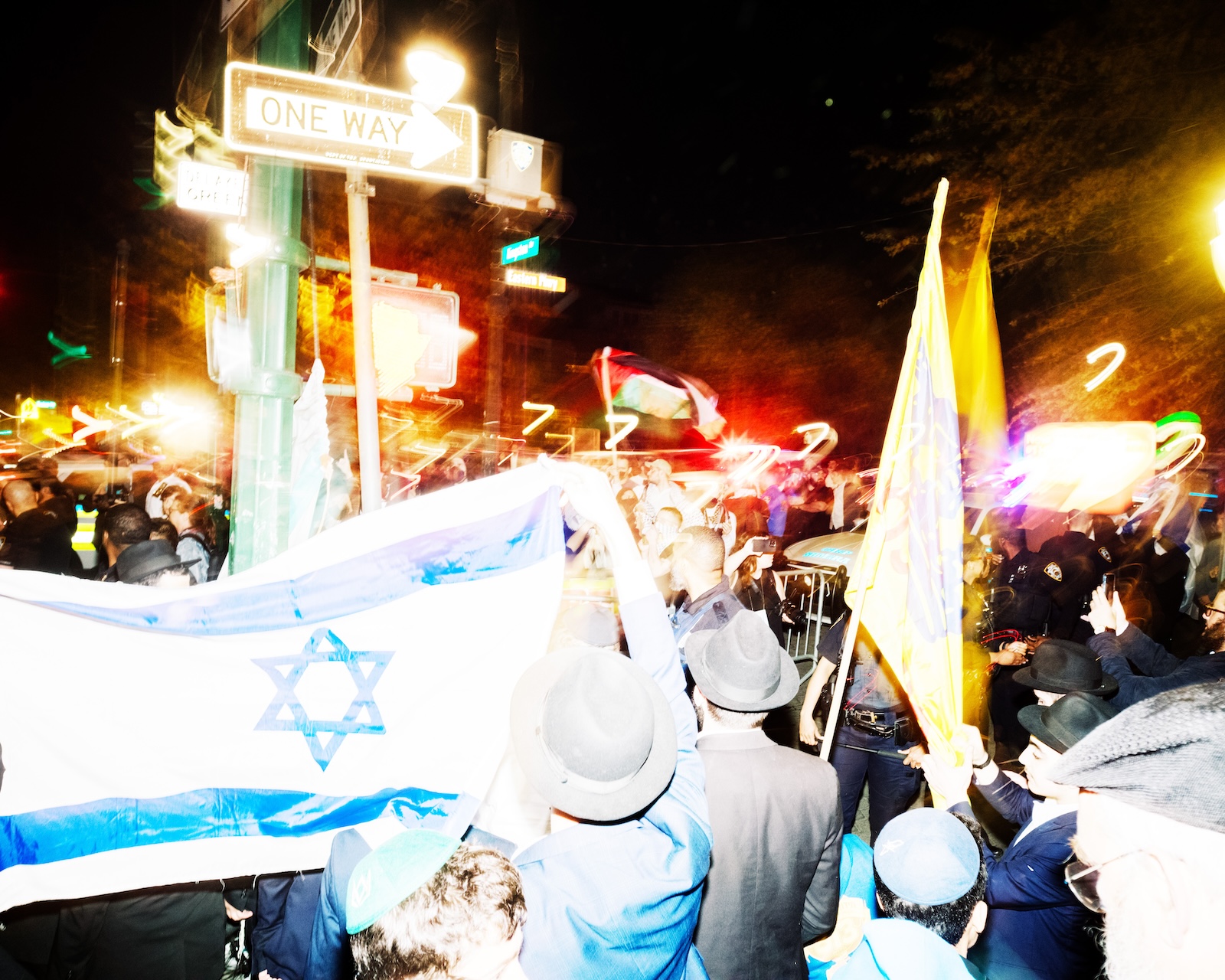
Two weeks ago, a group of about two hundred protestors took buses and cars to the Modern Orthodox Young Israel synagogue in Kew Gardens Hills, Queens, about twenty minutes from Montefiore Cemetery. The synagogue was hosting a stolen Palestinian land sale on behalf of Tivuch Shelly, a “real estate company” established in 1989 to facilitate settlement in the occupied West Bank. Events like these happen regularly in New York and New Jersey across most kinds of Jewish congregation, from the Bobover Hasids in Borough Park to the Congregation Ketr Torah in Teaneck to the Park East Orthodox Synagogue in Manhattan, and over the past two years they have been picketed with increasing frequency and fervor. The Palestinian community organization leading these pickets, PAL-Awda New York/New Jersey, has correctly identified land sales as an essential site of struggle, and their mobilizing program has led to several sales and settler recruitment fairs being cancelled. They have also raised the ire of Zionist counter-protestors, who took their own buses and cars (or simply walked down the street) to meet our people with chants of “death to Arabs,” waving the yellow flag of the Kach. The resulting clash was as close as you can get to live and unmediated settler violence without going to the settlements themselves.
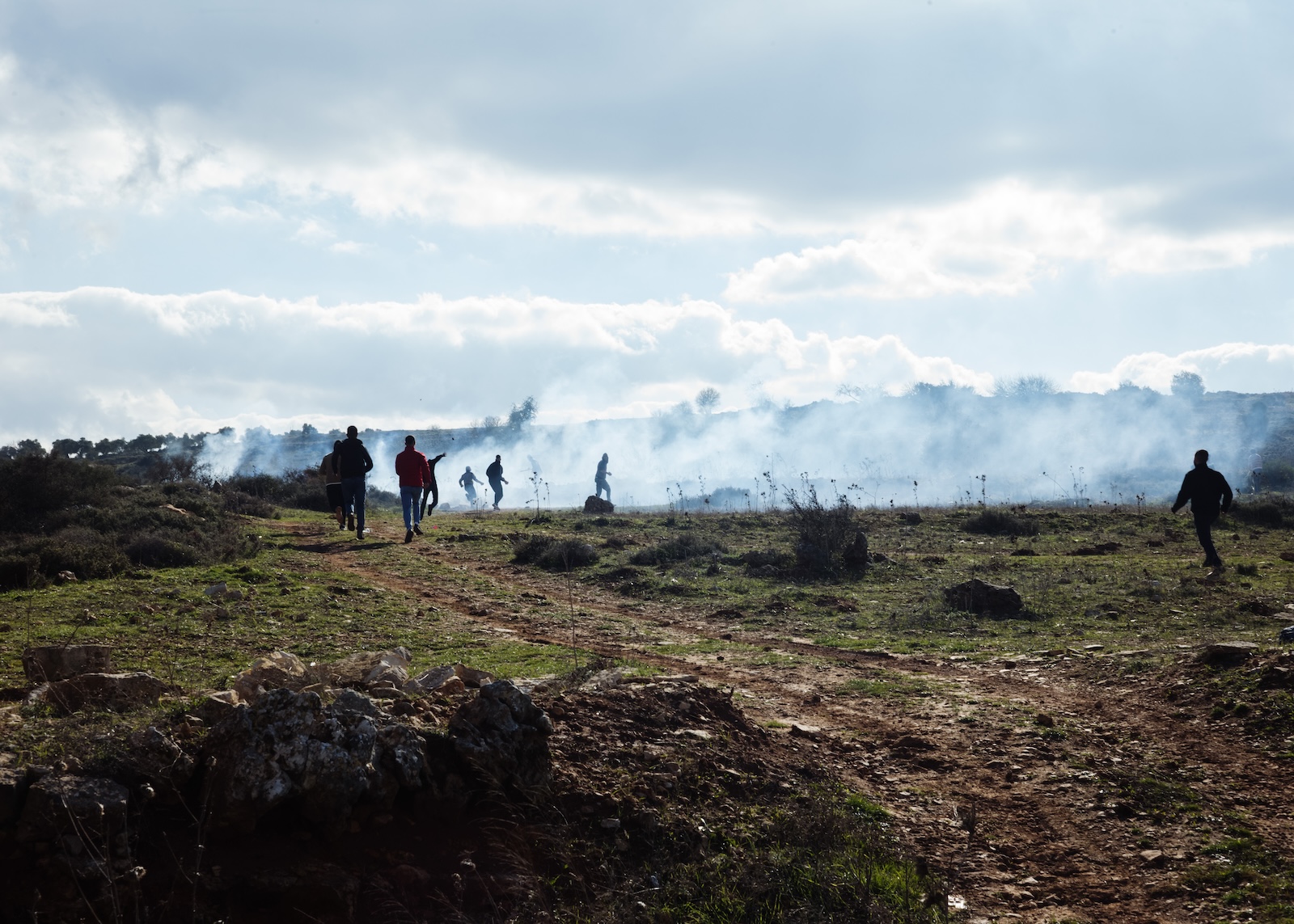
Since its inception, the Zionist project has been a product of the coordination between Western (Christian) imperialist planning and a Jewish supremacist settler colonial movement. The naked entitlement of the land sales notwithstanding, they are a small part of the capitalist latticework of New York City that facilitates and coordinates Jewish settlement in Palestine: public pension investments, asset managers, international bond offerings, security coordination and intelligence sharing, academic institutional collaborations, arms manufacturers and logistics companies, art-world money laundering, the blood diamond trade, and so on. Of course, New York also boasts or once boasted the headquarters of many Zionist institutions like the Jewish National Fund, the World Jewish Congress (which meets annually at MoMA), and the Anti-Defamation League. But it is the synagogues — proselytizing Zionism, coordinating the transfer of money to the settler movement, and radicalizing Jewish youth to fight in the Israeli occupation army — that have gone unchallenged by most left and liberal forces.
Land sale protests are an essential form of community response to collusion between religious institutions, the state and city legislatures, the police, real estate, and finance capital to arm and equip the Israeli project with human and military capital — collusion that establishes the living, transnational infrastructure of the Zionist movement that has usurped Palestine from its Indigenous inhabitants and enacted their stepwise forcible transfer and extermination over the last hundred years. Of course this must be protested, whether or not it is facilitated inside houses of worship. And of course, the police will do everything in their power to protect it. The massive police response to the action closed down the block, as cops set up barricades away from the synagogue and adjacent yeshiva and threatened to kettle community members, most of whom were Arab and Muslim. In a video that circulated on X, the protestors could be heard chanting, “Say it loud, say it clear! We support Hamas here!”
Condemnations followed from almost every political figure we expect to defend the status quo: Senate Minority Leader Chuck Schumer, New York Governor Kathy Hochul, New York Attorney General Letitia James, and Congresswoman Alexandria Ocasio-Cortez, who decided the subject warranted “hey, so” aughts-era Tumblr snark. Others entered the fray presumably for the love of the game, like District 39 Council Member Shahana Hanif, who linked the action to a synagogue arson in Mississippi, or District 37 Council Member Sandy Nurse, who had been photographed two years prior with her fist raised at the Columbia University Palestine encampments. The public script was predictable: Hamas is a terrorist organization. Support for Hamas, especially when declared in front of Jewish people, is antisemitic. And the implication was clear: We do not condemn the illegal sales of Palestinian land in New York City’s synagogues, just as we support legislative measures to ban any such protests against them.
A cavalcade of hacks, frauds, and sycophants latched onto the Zionist reaction, producing a handy spate of rubbernecking news pieces, handwringing op-eds and thinkpieces, and pearl-clutching social media posts with which to delegitimize the Palestine movement. The public was made to understand, in effect, that Kew Gardens has the right to defend itself, even or especially against words they do not want to hear. Little, if anything, was said of a city whose message to Palestinians is their disposability, a city whose media apparatus continually broadcasts soft and loud endorsements of annihilation in Gaza. The intention of these circuses is to naturalize a topography of imperial life in New York that is structurally permissive of Jewish supremacy. Their message is that Palestinians should die quietly.
The overall effect of this media storm was to deliberately obscure public understanding of what was being protested. One of the Israeli government’s most coveted efforts is the E1 corridor, a network of proposed developments connecting East Jerusalem to the Ma’ale Adumim mega-city settlement that would bifurcate the West Bank, separating northern towns and cities like Jenin and Nablus from southern ones like Hebron and Bethlehem. Last month, after years of delays stemming in part from international objections, the Netanyahu government released a tender for developer bids. The sale of lands and properties in Ma’ale Adumim that occurred at the Kew Gardens Hills synagogue constitutes a form of capital and population transfer directly into the tendons of this project, furnishing ‘facts on the ground,’ and directly arming the strangulation of Palestinian life in the West Bank, itself already controlled by a constellation of Israeli checkpoints.
In the eye of the tempest, Mamdani’s words were anxiously awaited. The media had primed the city: This would be Mamdani’s “first test.” The mayor released one quote tweet of a New York Times article on the protest and reproved the chanters for supporting a “terrorist organization” before reiterating that he would ensure houses of worship remained safe for all New Yorkers. This arrived just as Governor Hochul affirmed her intention to use the state budget to pass into law a ban on protests within 25 feet of houses of worship (termed a “safety zone”) and is contextualized by Mamdani’s own first week Executive Order instructing Police Commissioner Jessica Tisch to review city compliance with the federal FACE Act. For Muslims in New York City — who overwhelmingly voted for Mamdani — the pretty fiction of the sacrosanct house of worship landed awkwardly, given that city and state alike have spent two and half decades subjecting its masajid to surveillance, infiltration, and de-radicalization programs. At a press conference the next day, Mamdani was pushed to clarify his position on the sales themselves, to which he replied that, consistent with international law, he was opposed to illegal sales of land in the occupied West Bank. He did not, however, indicate that he had any intention of stopping them.
We cannot ridicule Zionist organizers out of selling Palestinian land, or shame American politicians into agreeing with us. There are several strategies that can and should be pursued simultaneously: making these sales inconvenient or impossible is one; making them politically, legally, or financially risky is another. The first strategy requires a diversity of tactics, some of which should not be put into print. The second requires engagement with juridical and governmental formations. Though difficult and slow, it is worthwhile to pursue legislative measures. Throughout 2023 and 2024, then-NY state assemblyman Mamdani was the primary legislative sponsor of the ‘Not On Our Dime’ bill, a proposed amendment to the state’s nonprofit laws to prohibit 501(c)(3) not-for-profit corporations from engaging in Israeli settlement activity, which was supported by a coalition of liberal nonprofits and community organizations, including Jewish Voice for Peace, Adalah Justice Project, and the New York chapter of the Democratic Socialists of America (DSA). Mamdani took up this effort at no small cost, earning the personal condemnation of dozens of his colleagues in the state legislature at the time, who signed an open letter calling him and his bill antisemitic. Certainly, the conditions are now wracked with different contradictions: the coalition that swept Mamdani into power is more staunchly anti-Zionist than before, but also, he now serves as the executive of the global capital of finance and imperial planning. Put plainly, this means he answers to bankers, landlords, and cops. We as a movement must face this reality, and accordingly must build the widest possible coalition to help end the land sales by a number of means, including by lawfare.
Mamdani’s administration is not a monolith, and there are different political currents within it with different relationships to Zionism. One task of the Palestinian liberation movement is to equip elements of the administration who seek to advance the objectives of the struggle. These elements tend to require broad bases of support, with a coherent narrative, tangible asks, and, importantly, a legitimate threat of rescinded support or the ability to damage the current governing coalition. This means that very little can be achieved by an anti-Zionist program that promises to support Mamdani’s re-election under any condition. This same calculus may not be as true for other left struggles, which regularly embrace the ‘party stalwart’ calculation. Despite mass popular support, Palestine remains a third rail of U.S. electoral politics across party lines. The DSA has the ability to move thousands into action around the current crisis, in line with the commitments it made when passing its national anti-Zionist resolution. Such a commitment would build enduring links to the mass, grassroots movement in support of Palestine that has been built over the last half-decade.
For the leftmost flank of organizers who now have influence at City Hall, the de facto reference point on the Palestinian cause is Jewish Voice for Peace, whose highly active New York City chapter went all-in on Mamdani. Certainly there is no organization that has done more to visibilize Jewish people in solidarity with Palestine. Yet the reality remains that many of the Jewish social formations being organized are net beneficiaries of the imperial system and Zionist settler colonialism they aim to oppose, and this contradiction can only be resolved through the development of a strong anti-Zionist ideological line by which all members must abide (or be disciplined). Like any such line, it must be strengthened through praxis. The land sale protests can be that praxis.
JVP’s leadership has been historically reluctant to engage in any form of protest inside or outside synagogues, fearing that to do so would be to fracture their rapidly growing base. This rationale should be re-examined, given that the exigencies of Palestinian land struggle are now, finally, after two years of livestreamed genocide, understood around the world as a life-and-death matter. On January 9, JVP put out a statement saying they “object to the use of synagogues to enable the expulsion of Palestinians from their homes.” Within Our Lifetime’s Nerdeen Kiswani responded on X, saying, “You guys should be the ones protesting them then.” Many of the city’s organizers are thinking, if not saying, the same thing. The lack of a mass Jewish presence makes vulnerable those who do show up to protest the land sales, like Jews Against White Supremacy (JAWS) and the Neturei Karta, two groups we commend for their regular support. It also limits the movement’s ability to actualize our demands in the present conjuncture.
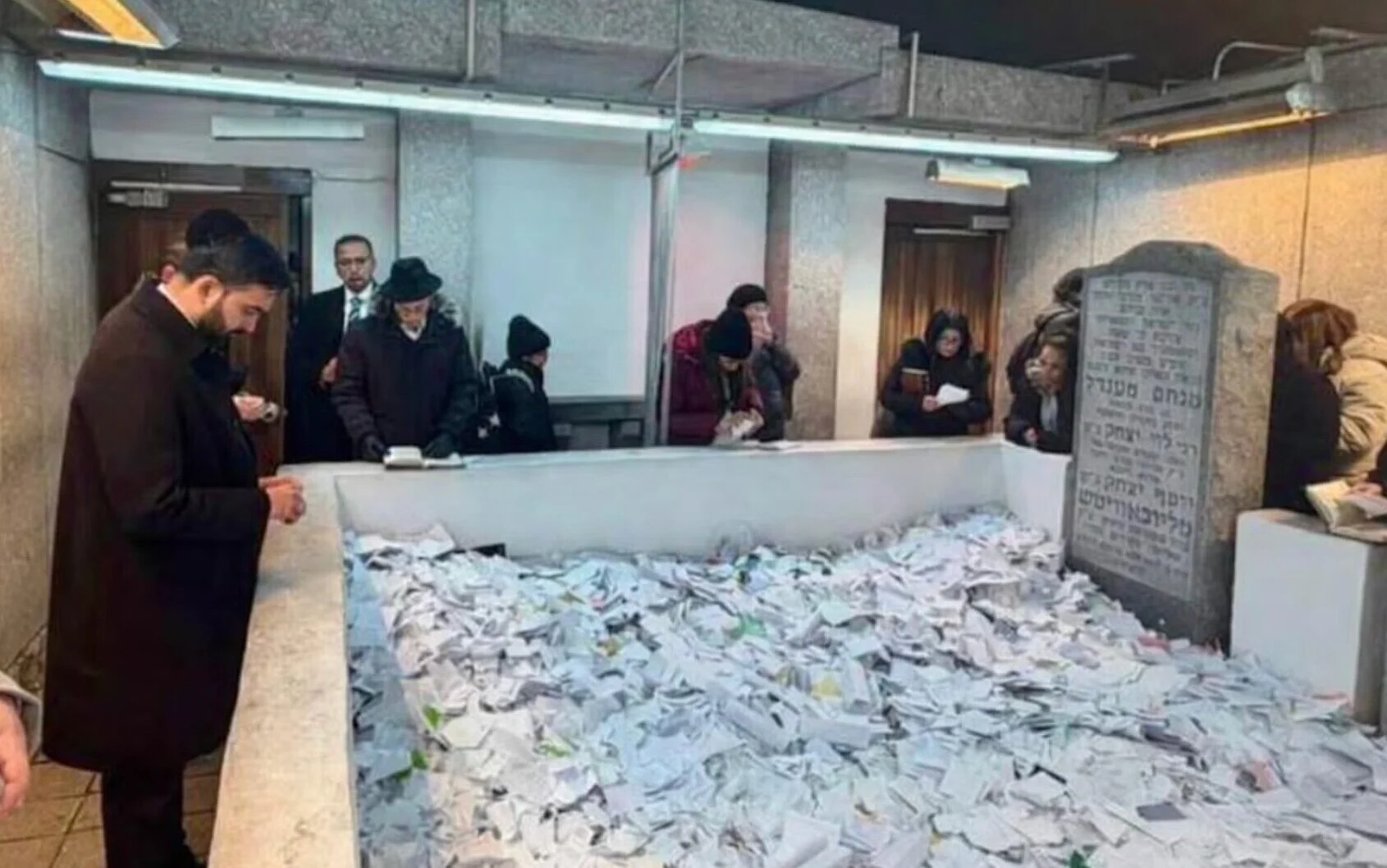
If we return now to the sight of Mamdani at Montefiore Cemetery, it’s because the image is the clearest manifestation of this conjuncture — a leaked glimpse into the real machinations of power, made all the more sobering because, unlike most of our protests, it wasn’t meant to be seen. Public displays of fealty to the dying world order are no longer advisable for the new mayor, yet privately he is still constrained by hegemonic forces. This doesn’t mean we abandon attention-getting tactics altogether: It’s worth noting that the sensationalism around the Kew Gardens protest helped draw support from some leftists and liberals who previously were silent on the issue of land sales at synagogues. But if we depend on Zionist reaction to make the case for our actions, we risk a situation in which much of the movement’s energy is spent fighting repression, such that our wins constitute recognition of basic rights.
For the hegemonic forces, the nominal ceasefire has produced a hope that the Palestine question will, in effect, disappear; that politicians will no longer face pressure to act against normalization; that the movement is too weak to effect any sort of accountability for the perpetrators of relentless, sadistic violence in Gaza.
What do you do when your back is up against the wall? The Palestine movement in North America has certain qualitative strengths: organized cadre, a mass base, theoretical foundations borne of our people’s historic struggle, and broad sectors of popular support and organizational solidarity from left formations. We engage in politics on the trepidatory note of the possible, clear-eyed about our enemies: those who have enacted or facilitated mass murder by air and fire in Gaza, who sleep too easily in our neighborhoods and our cities. We fight until their altars and settlements are bitter ruins.