

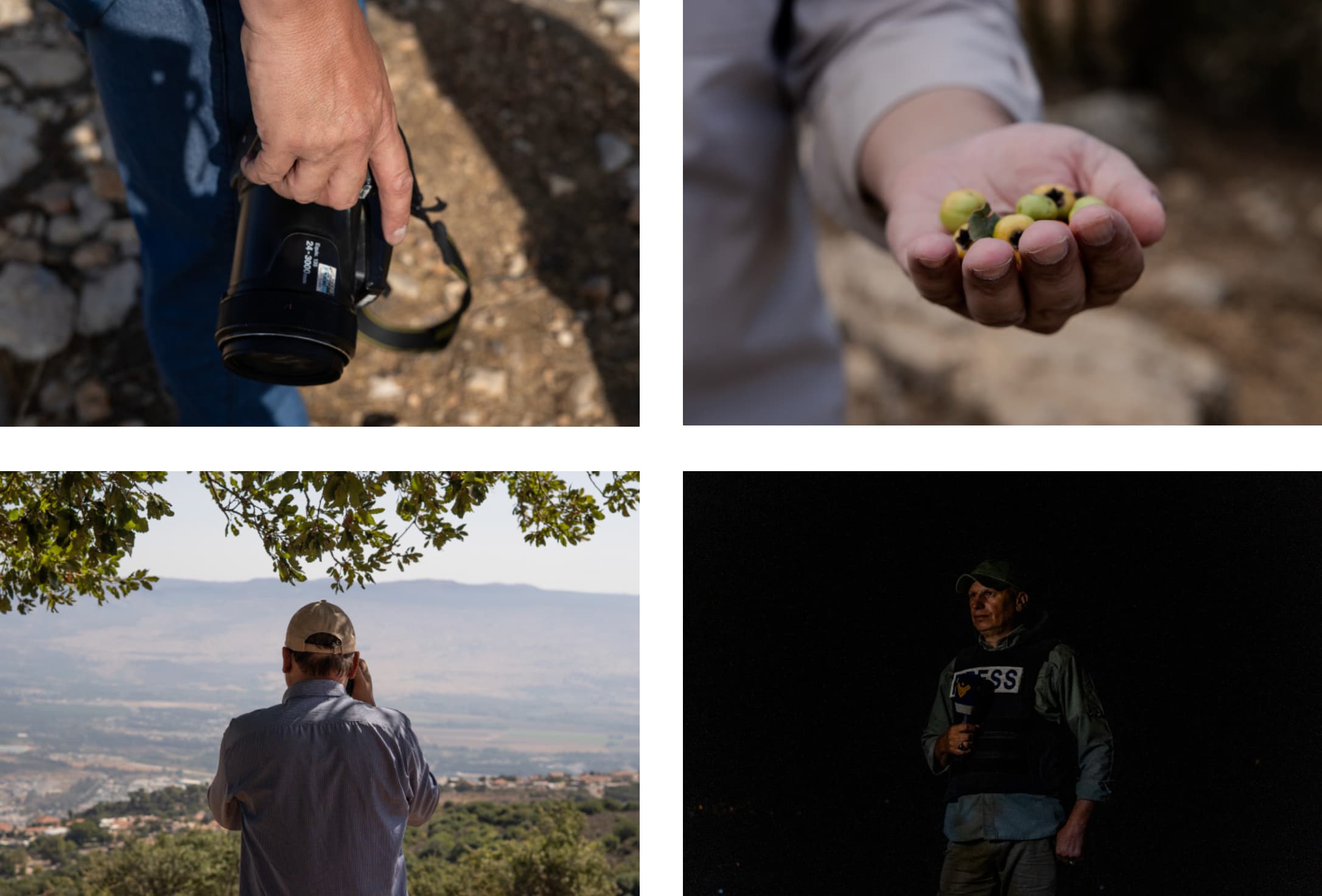
To our teacher, Hajj Ali Shoeib,
I write to you after you have been reunited with the warmth of the earth — a tepid warmth, for you remain far away from your village, al-Sharqiyya. But we know that your final return can only be upon the land you committed to memory, upon the borders where you stood guard.
We ought to confess: After your passing, the borders have been further displaced, the news has been made ominous, insufficient without your accompanying signature: “Ali Shuaib — News of the Border.” We revisit your legacy, in search of your secret.
How were you so attuned to the murmur of the valleys and mountains?
Who kept you company after the death of your cameraman, Wisam, your closest companion, who was martyred in the 2024 war while sheltering in an area supposedly designated for journalists? I recall that from the site of the attack you declared: “I film myself because my cameraman, who accompanied me for months, has been martyred.” You were a teacher with your words. “This is the martyred image,” you often said.
So what is this image that has become, itself, a martyr?
You spoke to us about people grumbling after every broadcast, because you did not pass by their home, or make their rooftop your stage. Every homeowner wanted to offer you their window, to see their village through your lens. Not one person hesitated to give you access to their home. You told us some even left their keys hidden beneath the doorsteps, that you knew where to find them even if they were not around.
You laughed as you told us the story of an elderly woman who left you a letter saying she would not forgive you for not finishing the plate of mulukhiyyah she had prepared for you. And the fuss from locals would always return: “Why didn’t you mention the raid on our village?” “Why didn’t you come by our neighborhood?” “Where were you the day we buried our men?” Smiling as usual, you noted that these comments were not reproach for a missed news story, but rather spirited banter directed at a relative late for his routine visit. You taught us that villages are not raw material for journalistic coverage, but homes where we find shelter.
You stood in front of the camera, but we saw you standing beside us. You did not merely show us the South, you taught us how to see. You spent your days transmitting images, but your voice remains the clearest of them all. Your voice is the first image.
I search for your name among my old notes, and find the transcript of an interview with you that I never conducted. I don’t know what delusion had taken hold of me for me to have fabricated that exchange, for I had thought that whenever we had a question for you, we would find you between the Metulla settlement and the plain beneath Khiam.
Do you miss sitting beneath a tree near al-Abbad, where you would regularly station to monitor the movements of Israeli soldiers?
What crossed your mind as you stood in Khiam, declaring that the village had not fallen, despite the spiteful enemy’s encroachment? Did you imagine the occupation’s gates collapsing at al-Qantara as they did in 2000, an event you captured with your own lens? What memories surfaced as you returned, time and time again, to bear witness to war and displacement in the same villages over the years?
Do you know that the enemy boasts of your murder? They published photographs showing your car, which they struck as you returned from an assignment with your colleague Fatima Ftouni and her brother, Mohammad.
They did not kill you at the border itself, but on your way back. Perhaps what terrified them most was neither the news you reported nor the images you documented, nor the comfort you provided us younger journalists. Indeed, the source of the enemy’s anxiety must have been the very fact of your perception. What frightened them was that you were watching them. Before the South’s liberation and afterwards, it was you who exposed them, sniped them daily with your lens.
We never felt reassured about the state of our villages and people until we saw you reporting on them. As for today, we are confident that you have found your place. We once yearned for you as our voice and witness. Perhaps today, we need you even more as a martyr.
To the guardian of our borders, rest in peace in the boundless heights.
Rest assured that we will not close our eyes, and we will not look away.
Sincerely,
Your loyal students
This piece appears in the twenty-second issue of The New York War Crimes.