


After Al-Aqsa Flood, when the U.S. and Israel set out to devastate Gaza, activists in the West tried to meet the strength, stamina, and ingenuity of resistance fighters on the ground. This was a difficult, even contradictory, task. “Activism implies an internal framework, a working with to effect change,” the Lebanese communist Soha Bechara told the magazine Al Hayya in 2022. “As for resistance, the term leaves no space for there to be any sort of with.”
For three years now, the Palestine solidarity movement has transformed and experimented with mixed results. We have worked, and succeeded, to raise global awareness of a genocide that we have failed to stop. Even as more of us profess anti-imperialist politics from the imperial core, we suffer from a profound confusion about whether we are truly working against what we oppose. As the U.S. and Israel expand this genocidal war across the region, it is imperative that we resolve our aims.
This past summer, we invited organizers from across our network to a critical and self-critical discussion about the state of the Palestine solidarity movement.
Participants included: Leiala Mohammad, a member of PAL-Awda NY/NJ, a grassroots organization focused on stopping the sale of stolen Palestinian land; Len Inniss, a former member of Palestine Action, a direct-action group founded in 2020 and proscribed by the U.K. government in 2025; Tara al-Alami, the former general coordinator of the Palestinian Feminist Collective (PFC) and a member of Writers Against the War on Gaza (WAWOG), which publishes The New York War Crimes; Abdullah Farooq, who sits on the National Political Committee and the National Arms Embargo Committee of the Democratic Socialists of America (DSA); and Alex Colston, a journalist who sailed with the Global Sumud Flotilla (GSF) in 2025 and 2026.
These participants offer a range of perspectives across organization, place, tactic, and political perspective, as well as a willingness to disagree in good faith.
This conversation, which took place on July 11, 2026, has been edited for length, flow, and clarity, as well as for the security of the participants. The final question was posed several weeks later over text.

NYWC: Let’s start at the heart of this struggle: land, and the right of return. Leiala, can you explain how land in Palestine becomes available for sale, how it gets sold, and what we can do — besides protest — to stop these sales?
Leiala: What they’re doing in these land sales is far more significant than meets the eye. It allows the settler colony to create a record of “ownership” of Palestinian lands that becomes impossible to dislodge. They’re laying a framework that ensures that stolen land is going to be part of the future state.
Alex: I’m curious if the way that you approach it is guided by focusing on particular places, particular neighborhoods, particular villages.
Leiala: Our approach is a little reactive. When we find out that there is a land sale happening in New York City, we target the sale itself. We try to identify who’s responsible for carrying it out. We try to figure out where the land is being sold. We protest the real estate events themselves, and then we’ll protest Nefesh B’nefesh, an organization that facilitates land theft and Palestinian dispossession.
Len: The tactics are mostly protests held outside these “Land Sale” events, is that right?
Leiala: Yes. We try to get people to infiltrate, but the only people they’ll let inside are Orthodox Jews. For the most part, the actions that we have done are outside these events.
Len: Have any of the events been stopped?
Leiala: The very first sale that we found out about, which was happening in Brooklyn. This was in 2024. That event was shut down. We worked with the PAL Law Commission to serve legal demand letters to the physical hosts of the events, typically synagogues, and, when possible, the sponsors, though usually the sponsors are real estate agents in Israel with no local addresses. We have also served these letters to the New York and New Jersey attorneys general. In New Jersey, legal papers were served at the home where someone was hosting a Palestinian land sale event. One of our comrades is now being charged federally for that, among other charges they and several other people are facing related to the ensuing Palestinian land sale protest.
NYWC: What is the material reality that follows from an unstopped land sale?
Leiala: When you attach a name, especially if it’s an American name, especially if it’s a rich white person, it becomes even more difficult to later take this land back.
Let’s say there are some kind of trials and people are held accountable. You’re replacing the past with this piece of paper that says “I own this and I’m an innocent person who bought a piece of land that is now mine, so what justice am I going to get if you are bringing back the rightful owners of this land?”
They are also trying to create this as a market: “I want an apartment in Israel. Every Jew should have an apartment in Israel.” They’re targeting Jewish supremacists. They’re targeting ultra-Orthodox Jews. They’re targeting Jews desiring second homes.
They want the people who will be okay with ethnic cleansing, and the ones who will sign themselves and their sons up for settler militias. They want the people that will send their children into the IOF to do more ethnic cleansing, not only in Palestine and not only in the West Bank, but in Lebanon, in Syria.
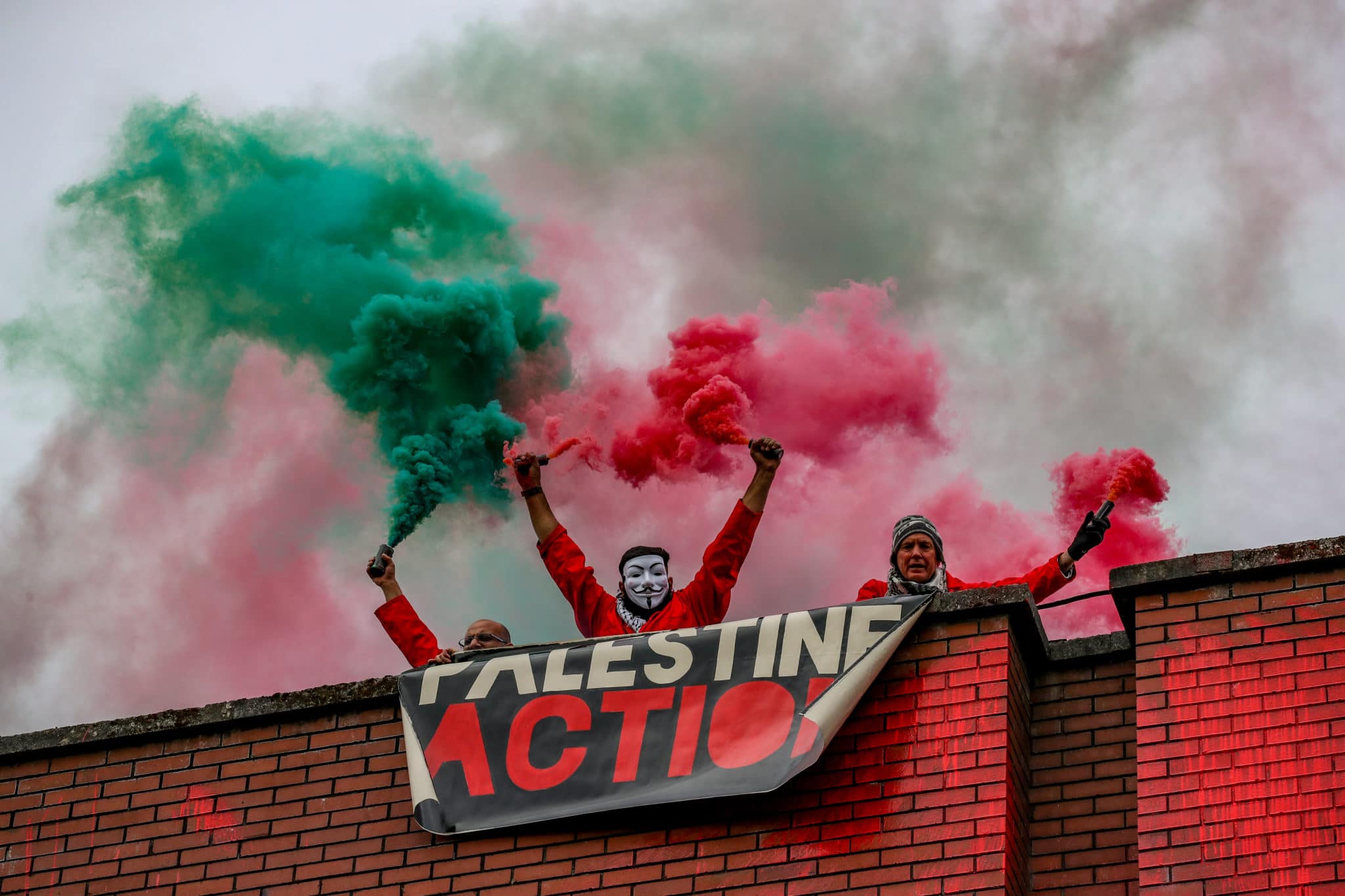
NYWC: The entity can do anything by force and money, but the use of force still has to be shored up by narratives grounded in process, legality, institutional legitimacy. Without institutional or legal backing, what are our levers of action? Len, could you speak to the effects that the terrorism designation had on Palestine Action, and what does basebuilding look like now that the designation has made it inherently risky to belong to this base of people?
Len: Palestine Action stopped existing the moment it was proscribed. Under the law, the membership rolls are presumed to be completely void. And if you give the government reason to think that you are still a member, they can put you in prison for 14 years.
I think we should all be materialists about this. The government gets to do what it wants to do. For years, organizers around the world tried to stop the Jewish National Fund, which takes and holds land for the sake of Jewish settlement. Eventually, Canada managed to strip the JNF of its charitable status; nevertheless, Israeli racist land practices continue unabated.
The reason Palestine Action attracted so much attention is because Palestine Action was really effective. Permanently shutting down weapons factories, especially during a genocide, is a really big deal.
We have several new direct action groups that have risen up out of the ashes. Today, People Against Genocide simultaneously attacked multiple weapons factories in the U.K. Direct action cannot be proscribed as a tactic. And it continues to get the goods here.
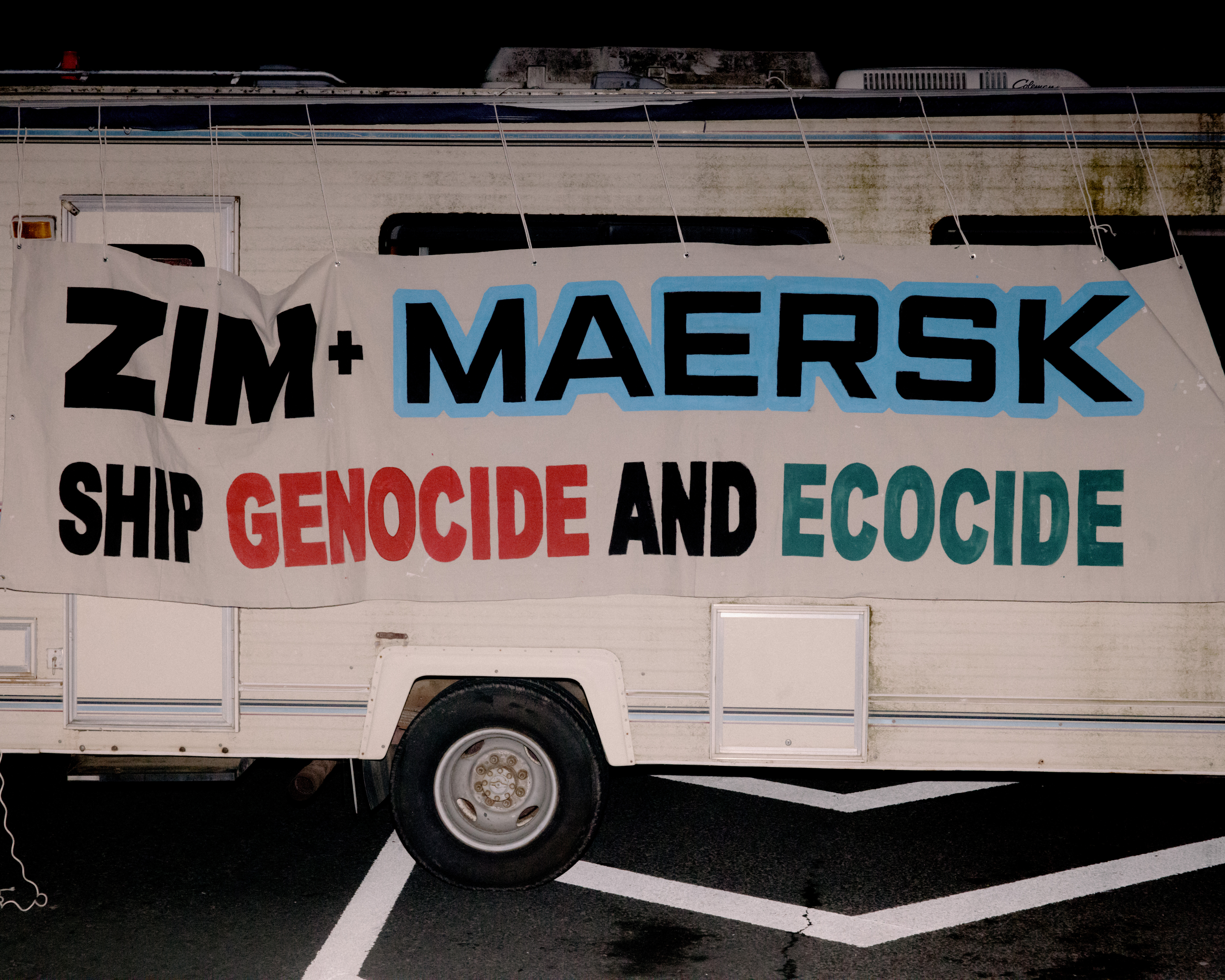
It’s important to note, though, that people are in jail right now in the U.K. for smashing up weapons that were first made at the Brooklyn Navy Yard. If Elbit weapons are being made on New York State property, on New York-owned land in New York, then surely this great new mayor should have something to say about that.

NYWC: Has the terrorist designation chilled or slowed the desire to do this direct action? Or are more people invested because of the crackdown?
Len: There are so many people who have been galvanized. People who had no idea about Elbit now think of it as an entity that saps up their own civil liberties.
But to say that it hasn’t affected our ability to recruit would be silly. Also, we had built incredible platforms. Even though we had a complicated, multiple-city attack on Elbit happening in the U.K. today, almost nobody found out about it because we went from having literally a million followers across platforms to less than 50,000.
In a post-proscription atmosphere — and in the States, a post-Prairieland atmosphere — doing stuff where you get caught is really scary. I would recommend not getting caught.
We know that drones made in Brooklyn Navy Yard are being shipped via the U.K. to Gaza. What is the point of electing people who are sold to us as being on our side if they’re not going to be on our side when we smash up Israeli drones being made in our backyard?
NYWC: Can we hear about the electoral strategy that DSA has been engaged in and how that relates to the Palestine liberation movement?
Abdullah: The analysis that motivated our arms embargo work was twofold.
First: If we know that Israel as a terrorist state can only be stopped if we cut off the flow of weapons, then how do we actually do this?
Second: A supermajority of Americans support an arms embargo. How do we try to express that majority?
Our goal is to be able to take those majorities and actually build them in Congress, build them at the levels of city councils and exercise power, the kinds of power that Zohran Mamdani currently has in New York.
The goal of building a mass organization like DSA is to be able to inform an elected leader like Zohran that these are our priorities. To build support for an arms embargo in Brooklyn Navy Yard we need to go out and organize, talk to more of our coworkers, talk to our neighbors, talk to more people, get them to build this kind of mass organization.
Our electeds are going to see that and say this is a priority of people that live in New York City, and we need to take action on it.
Len: Are we all watching the same genocide? No offense, but the plan to eventually somehow get to a point where we can take state power and actually enact a meaningful weapons embargo feels based in something other than reality.
People want to do more. They really want to do more. As of last year, the majority of people living in the U.K. supported a full weapons embargo, and no political party — with the exception of the Greens — offered one. What are we telling people who can’t wait around for however many election cycles and want to actually stop the genocide now?
What Palestine Action told people in the U.K. is that if you undertake action to stop weapons from getting to Israel and you end up accused of a crime, we are going to work night and day to get you out of jail. We are going to make your court cases the thing that everyone goes to, rather than the next march.
We have built a movement around the people who are actually smashing up the weapons rather than building a movement around getting people elected. There’s a reason that prisoner solidarity is one of the pillars of Palestinian society and why prisoner release was the aim of the operation on October 7, 2023.
Prisoner solidarity is constitutive of Palestinian solidarity. This is not a struggle that can be served by people who preach nonviolence in the face of colonial force. We should be sober about the use of extra-legal tactics, of course. But we should also be willing to harness more of the energy of the movement for prisoner solidarity work.
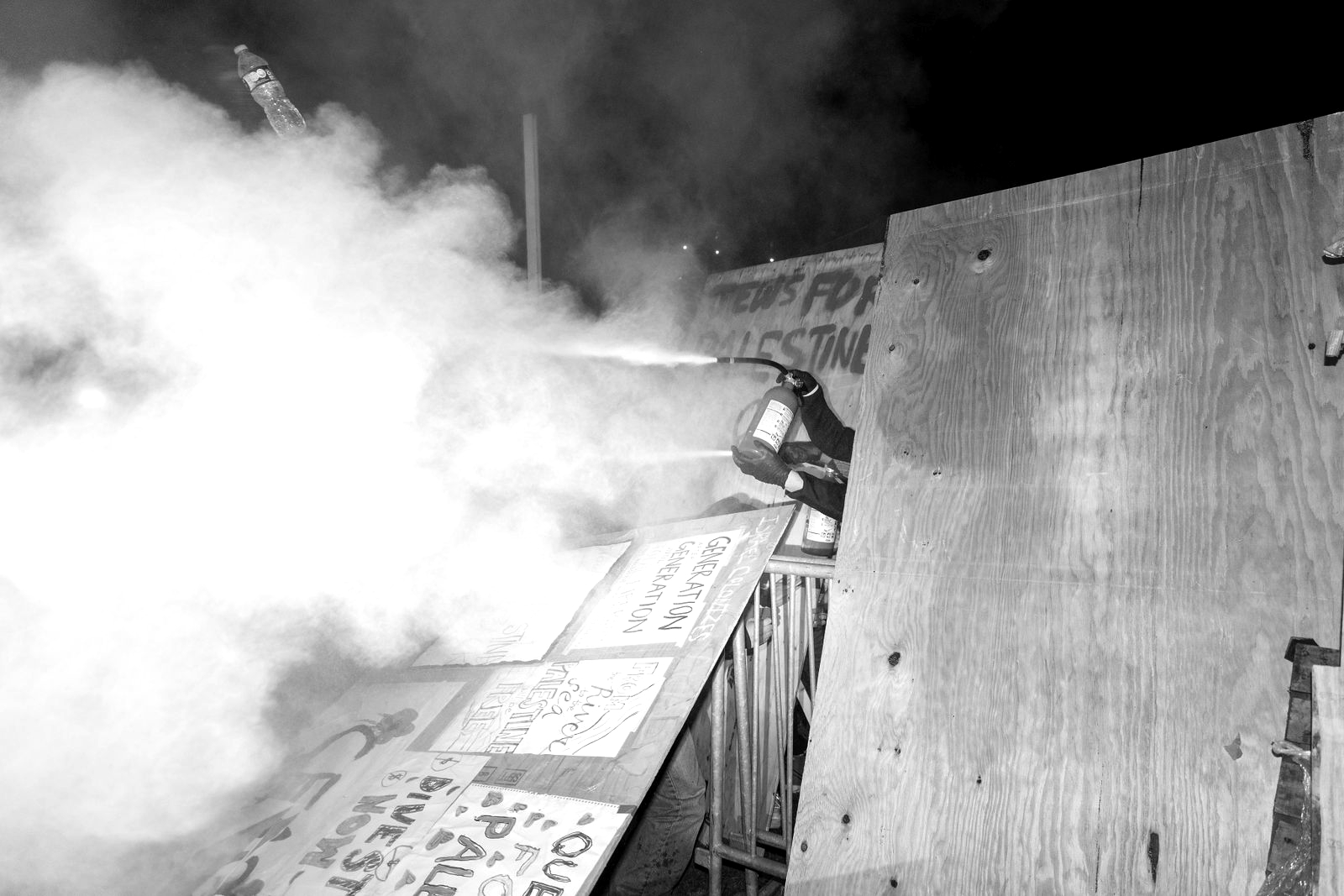
Alex: Having to deal with the state, police, and military, regardless of the tactics being discussed here, people should be way more responsible toward one another about consequences and risks. Which isn’t to say don’t do it. But if I could wish something into existence, it would be greater social care among our cadres, comrades, and friends toward people who are taking on the state in a meaningful way.
We should cultivate that far more vastly than we currently do. These attempts to take over the state in order to provide us protection are too much of a long term plan. We need to build out the capacity to protect one another and these ambitious, insurrectionist, autonomous, and even state projects.
That’s the thing I took back from the flotilla. For all the things we didn’t do or did do, I can say certainly that we took care of one another.
Abdullah: We take a lot of lessons for our arms embargo campaign from the Central America solidarity movement in the ‘80s, which successfully won an arms embargo on military support for the death squads in El Salvador. Over the course of six years, a well-coordinated solidarity movement was able to elect seven congressional representatives, but then was able to force a number of other representatives to change their positions. They wound up winning a congressional vote.
We know that we can do this again for Palestine. It’s going to take a variety of different tactics, and I’m not opposed to any of the tactics that people have mentioned.
As long as we’re constantly thinking, how is this actually impacting Israel’s war-fighting capabilities? How is this actually materially disrupting the flow of arms to Israel? And how is Israel responding to the actions that we’re taking?
Some recent comments by Netanyahu are very revealing. Netanyahu said, “Oh, we don’t need the U.S. to provide us with military support; we can get arms from India.”
I also want to highlight a recent amendment that’s being pushed in Congress to effectively fuse parts of the Israeli and U.S. military. This is being pushed because there is this fear that an arms embargo is getting more popular.
These two things demonstrate that our movement actually has the potential to exert this power.
If Israel is going to fight us on every front, in the electoral front, in the labor front, in the cultural front, we should fight them on every front as well.
Alex: You’re right. Netanyahu and the current Israeli government have long been making plans to be able to independently arm themselves apart from U.S. state investment. Capital doesn’t know any nationality.
They will find new ways to sell and manufacture and ship weapons. And there are ways to disrupt that supply chain via state intervention, and then there are methods that involve sabotage. It’s legitimate to say there is a longer term plan to bring state leverage against Israel, but that should never preclude the possibility of sabotaging supply chains directly.
Now, the direct action campaigns in the United States are not sufficiently socialized where the risk is shared and people are there to support them.
There’s not a proper infrastructure to protect people from this state or to act in the shadow of the state in a way that would prevent them from being targeted by the police and the military. Often people will go it alone, and that’s a tactical error on our part.
There is not enough preparation for defending the moral and political legitimacy of doing things that are illegal. We know intellectually that it’s legitimate for people to take those kinds of actions. But we do not have the proper legal and political infrastructure to protect people from the consequences.
They did do that for Pal Action and they were successful 70% of the time or so, but not every time. People were, in fact, indicted and convicted and faced extreme state punishment. The risk and the consequences are probably worth it, but we could do a lot better trying to protect people who are willing to take those kinds of actions.
So I think I can see both ways. To have state representatives willing to defend direct actions and sabotage and not tar them as terrorists would be a huge advantage. I don’t always see that from our cohort of insurgent electeds.

Tara: What we are dealing with is just different theories of change within different sectors of the movement. The stakes are way too high for disagreements that risk slowing down the work. DSA is a political organization within the American political landscape and will ultimately work within that framework.
If this were a revolutionary organization, the end goal of organizing for an arms embargo or for a free Palestine would be the defeat of the U.S. empire. I assume that is not the position of the DSA. That’s fine. When someone tells you who they are, you believe them, and you see how you can work with them, or up to what point you can work with them, and how you can broaden your coalition to the extent that it can be the most productive and useful.
This is why it’s important to also engage in a moment of self-criticism. The flotilla, for example, is a tactic that has been used for almost two decades. There are moments where it has achieved incremental wins and there are moments where it has cost people their lives, specifically in the early days. What I would see as the latest win is that it has further exposed Israeli impunity and their willingness to engage in sexual torture of foreigners, to kidnap them from foreign waters. That’s useful.
If we do this again, is it going to be useful? Probably not. People tried to get humanitarian aid into Gaza. The attempts were very well documented. The aftermath was very well documented. Now, the task is to prevent American amnesia from taking over, to prevent us from doing the same thing again in a few years, with the same result, and the cycle repeats.
This applies to every single sector of the movement. Whether it’s organizing politically within parties, working with mass collective popular actions like the flotilla, organizing general strikes internationally in Europe or here, national marches, which groups like the PYM and PFC have co-organized, convening people at national conferences like the People’s Conference and, importantly, participating in direct action.
Len: I agree. And I want to say that out loud twice. I agree.
The idea of empowering enough politicians to make it so the U.K. government is not a Zionist government is absurd.
And in the U.K., we’ve had to struggle against this idea that you could just get punched in the face a bunch of times and that would free Palestine. People would stop traffic on the bridge and get themselves beaten up by both police and civilians. The government heard us loud and clear, they just didn’t care.
This is my issue with policies of non-violence like these protest groups have, like the DSA has in NYC. If we are all on the exact same page about the moral imperative of stopping genocide, then what are we to make of this policy and this attitude toward people who are willing to use extralegal means of making a material difference? If we’re doing something that’s working and people “on our side” suggest other things to do instead that don’t work, are we really in the same movement?
Theory is a weapon — that’s not me, that’s Amílcar Cabral. Use it. Read, study, and then determine the causes of things so you can be effective. People aren’t stopping the genocide in part because they don’t understand why it is happening in the first place. If you try to fit Palestine into a racial analytic, you will march in the wrong direction. If you try to make Palestine a purely humanitarian cause, you will flounder on the shore of a colonial project.
I don’t know if the flotilla is getting punched in the face for Palestine or not, but I do think we should all ask ourselves what energy we’re asking people to devote to our thing and what energy will be lost if they listen to us and we’re wrong.
Abdullah: I want to highlight two current examples of places where arms embargoes have actually been achieved.
The first is Spain, where grassroots pressure, pressure from the unions and the labor movement, and people who were in elected office and able to apply pressure from within the government resulted in a full arms embargo. Research from the Palestinian Youth Movement and Progressive International highlighted how ships carrying U.S. military cargo were docking in Spain, basically convincing the foreign minister to adopt a position — even before there was an arms embargo — that those ships wouldn’t be allowed to dock. From there, with public pressure and with pressure from people within the administration, they were able to move to a full arms embargo.
Pedro Sánchez is not an anti-imperialist. He’s not a socialist. He’s center left. People didn’t wait for the next election cycle.
The second example I want to bring up is Belgium, where the very first union-led arms embargo that I know about was imposed in October of 2023. Workers and then the unions that represented them at Liège airport near Brussels were able to take a very strong position in support of an arms embargo.
This then resulted in political pressure that was being exerted by groups like the Belgian Workers Party. And then legal challenges and pressure as well. All of these forces coming together and exerting this power eventually won an arms embargo.
A lot of the enforcement of the arms embargo, both in Spain and in Belgium, has come from grassroots groups that are doing research, union members seeing a shipment happening here and there, and then using the grassroots pressure to enforce.
So I want to push back on the idea that we either have to work within institutions or we work outside of institutions. We want to build majorities and exert power wherever we can find the opportunity to cut off the supply of arms to Israel.
Leiala: At what point do we stop working with the systems that we know aren’t working for us, that we know have historically proven to work against us, that we know are going to take a while. At what point do we go against the system itself? What do we have to give up and what do we have to sacrifice to get there?
Can we even expect that kind of sacrifice living in the West or living in the U.S., operating under capitalistic societies? We are complacent.

Alex: To something that was said earlier about whether we’re just going on these ships to get our ass beat, we are not. We are sailing to Gaza. This is extremely important.
The flotilla as a tactic is part of a circulation struggle. A lot of goods, a lot of services, a lot of money go everywhere but to Gaza. What would it mean for people to organize themselves at a sufficient enough scale to provide basic necessities to people who need it most? This is the spirit and the concrete tactic of the flotilla. It’s one that can be reproduced in a bunch of different places.
Gaza is the place where it makes the most sense to try, because not only are we prevented from doing it, we are systematically jailed and tortured for doing it. That is not something that I want, wanted, ever want to do. It’s not something that anyone who is sailing on these ships ever wants to happen to them. But it is an ethic and it is a politic that is about meeting the needs of people where they are.
Does it become something else as it happens? A spectacle? A thing to expose the Israeli state? Yes. But these are all knock-on effects, not the primary intention.
What’s interesting about the flotilla as it’s grown from five ships to 55 ships is that its resources are being used. We have a huge map of a bunch of ports that activists want to block and they want to coordinate and collaborate with trade unions in these different states.
There’s finite energy, finite number of people, finite amounts of what people can do, but all of these tactics mutate. The flotilla has already mutated in many respects. There are people who are taking the tactic and reproducing it outside of the Global Sumud Flotilla.
Thankfully we have a pretty global majority who have supported the flotilla as a tactic. I’m grateful for it. I’m glad that people supported it. But we can achieve majority sentiment, no problem. The question is what can that sentiment be turned into?

NYWC: We are all talking about tactics that are not the number one way that our enemies are able to exert power, which is through violence. None of our organizations are capable of engaging in direct action that meets that kind of force. Sabotage sometimes seems like our greatest possibility. Our limitation here is quite obviously — for many different reasons — but obviously prison. Beyond prison, we are limited by the lack of desire within our movement to do that kind of action.
Abdullah: I resonate with the idea of us having finite capacity. That points to the need for us to grow and build our movement. We are in a moment where we have lots of popular support and we have to translate that popular support into power that can be exerted. The sky is the limit. We can go further with our rhetoric. But all of that is dependent on us being able to back up the people that we run for office.
I want to run someone for office who doesn’t believe that Israel has a right to exist; who is able to openly say Israel was founded through an act of terrorism and that all that land is Palestine.
But in order for us to be able to get to that point, we need to build a lot more power. We need to build a lot more support among trade unions, a lot more support among the types of organizations that are actually going to be able to sustain that approach.
Tara: Even if what you want is for the office itself to be abolished and destroyed, you should still be joining these organizations. It’s important to have different tendencies within organizations, within reason. Doing what you can with what you have is important. I don’t think we’re at a stage where it’s useful to come up with new organizations, for example. People should deal with the landscape that exists and try to push the struggle forward from within that landscape. Whether that’s DSA or other community grassroots organizations, whether it’s through advocacy organizations that aren’t political parties. All of this matters and is important.
But the question of whether we have popular support for Palestinian liberation and the end of the Zionist project remains unanswered, or maybe the answer is just no. I worry about using that term too loosely, especially in the U.S., because what would happen if we had popular support is a massive and material change in the flow of weapons, the flow of capital conditions domestically.
It’s strange to me why the U.S. or North America always seems to be behind the rest of the world when it comes to any anti-imperialist or progressive or anti-colonial movement. But understanding why is really important. It’s because this is the core of the capitalist beast.
There is value in playing into these contradictions and sharpening them in a way that creates more instability and more internal conflict within the heart of empire. What you are doing is trying to weaken the establishment that exists, to mobilize people around the idea that this establishment itself needs to crumble.
The way we can do this is not through seeking change from within, but organizing in a way that weakens the legs that it’s standing on, that weakens the infrastructure that it has built.
This is why I was asking, do we actually have popular support for Palestinian liberation, which necessarily means the end of Israel? I don’t think we do.
The average American is not someone who is engaging with the political landscape or engaging with the U.S. foreign policy or engaging with America’s involvement in several genocides, America’s exploitation of its own workers domestically, America’s history or present of capitalist encroachment, colonialism, and more at the same level that we are, or at the same level as members of our organizations. The average American is alienated and that is a condition of capitalism.
That’s important to admit, even though it’s not great and it could be demoralizing. Part of assessing the movement and assessing the wins that we have achieved is also accepting that.
We really need to assess the degree to which the people who control the world do not need popular support and the degree to which we actually have popular support at all.
Len: The ruling class can’t be persuaded or shamed out of its position. Look at the stock market throughout this genocide and what you see is wealth consolidation. They are not losing money on this. Their position is rational.
It’s important for people to understand that Zionism is not a belief structure or a structure of feeling, but rather a name for Yankee imperialism in the Middle East. We’re not trying to change people’s hearts and minds. We are trying to disrupt an imperial project and the way to do that is by raising the material cost.
And raising the cost works. Direct action works. Barclays, the U.K. bank, didn’t divest from Elbit because people were marching in the street past its branches; Barclays divested when thirty of its branches got smashed up in the same night. What else is delivering these results?
Tara: We should keep attempting different tactics. Some of them have worked. We should keep doing them. Some of them have not. We should put them aside for a while.
I’m not the person who would be joining DSA. I’m also not the person who would be, right now in my life, joining a direct action group and participating in high risk actions. But I am a person who is working with what I have and engaging in the movement in whatever way I think personally, politically, ideologically, materially is the most productive.
But the question of what’s the best way to move forward is a question for people who live in the West and are invested in life here to answer. And I’m not saying that it’s not a question that we should engage with as an Arab diaspora. But it is a question that must be answered collectively first or, at least, with enough collective engagement nationally and locally first, before we can actually engage in a sustainable movement that can still have setbacks, but is at least on the trajectory towards liberation.

NYWC: What would you tell a young person joining the movement today?
Alex: Never betray comrades, for to betray others is to betray yourself. Commit yourself in every way to flawed people, including yourself. As Lenin says, “the work of political agitation is never wasted.”
Len: Imagine you have one shot to make a difference in this struggle. If you heard about a group of kids stealing two million dollars from a bank, you would think it was incredible and wonder how they pulled it off. I have heard of kids who pulled off a coordinated military operation and smashed up two million dollars worth of military equipment, a war’s worth of drones, in twenty minutes. Things are possible that the adults in the room won’t tell you are possible. Now is a time that requires commitment, but it also requires creativity and ambition, because groups that are committed to themselves, to each other, and above all to the cause have historically done world-changing things.
If you face repression for doing nothing, you might as well do something.
Tara: Join and never look back. This is a national liberation struggle that is much bigger than an individual, a collective, or an organization. Remember our martyrs who have sacrificed everything and keep Palestine in front of your eyes, as Basil al-Araj said. Our task is to literally change the world, and we must allow ourselves to be transformed by this movement, too. Allow this struggle and all the pain that comes with it to make it impossible to live in a world where a genocide is debatable, negotiable, or conceivable in the first place.
Leiala: Sabah el-kheir. Welcome.
This piece appears in the twenty-third issue of The New York War Crimes.