

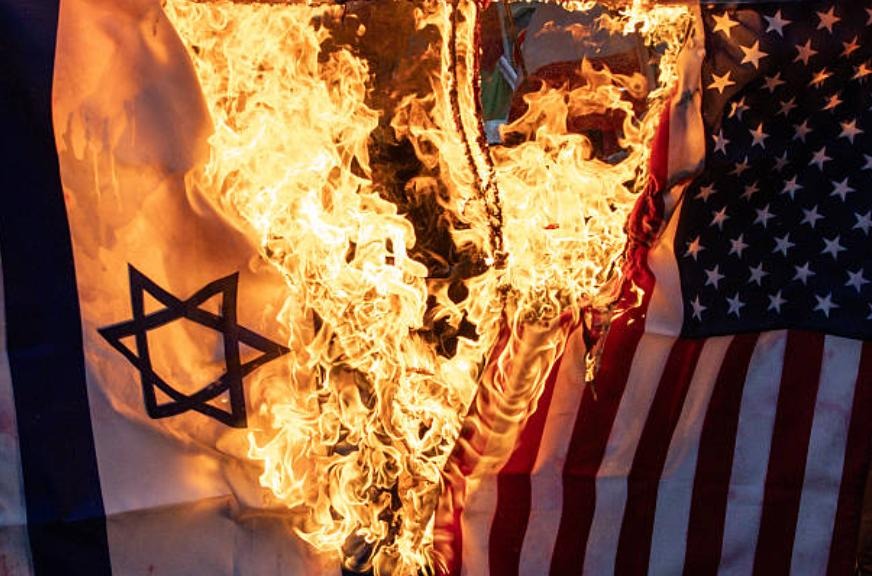
As the tide of Western public opinion turns against Israel and politicians weakly gesture to so-called fractures in the U.S.-Israel alliance, the two entities grow structurally evermore intertwined.
The latest collapse of the fiction that Israel and the United States are separate military and political bodies comes in the form of the new military funding package being pushed through Congress: Section 219 of the National Defense Authorization Act (NDAA), also known as the United States-Israel Defense Technology Cooperation Initiative.
The United States and Israel have long functioned as military partners, but Section 219 of the NDAA would shift the occupation’s status from a recipient of U.S. aid to an even more deeply entrenched military partner.
The legislation seeks to create a unique role at the Pentagon responsible for its advancement; commit the U.S. to perform bilateral military research and development with the Zionist entity; and lock Israeli biotechnological weapons, AI research, and drone technologies into the U.S. supply chain.
Over the past 80 years, the U.S. has spent over $300 billion (adjusted for inflation) on establishing and supporting the Zionist occupation of Palestine. Since 1974, Israel has been the United States’ top aid recipient. For nearly three decades, the U.S. Congress has established annual memoranda of understanding to provide the Zionist entity with military funding. The U.S. has committed to providing the entity with $3.8 billion in military funding per year for the 2019 fiscal year through fiscal year 2028, though the actual amount is much larger, owing to a variety of multisectoral public subsidies and funding for direct commercial sales of military equipment. The funding had to be authorized by Congress every year.
After Al-Aqsa Flood, the U.S. poured additional billions into the occupation to support the genocide in Gaza. Between October 7, 2023, and September 2025, the United States sent the Zionist entity more than $20 billion. Aid totals do not include arms sales, which amount to billions more: Israel was the third highest recipient of U.S. arms sales for the period from 1950 to 2024, and at least 78% of its arms imports since 2000 have come from the United States.
But for the overlapping U.S. and Israeli ruling classes who run these governments, this is not enough. Politicians across the spectrum are working to implement legislation that would allow for guaranteed, increased, and closer support without even the need for congressional approval. Section 219 replaces the required annual passage of memoranda of understanding with a permanent fusion of the U.S. and Israeli militaries.
Backed by AIPAC and the Zionist think tank Foundation for Defense of Democracies, the United States–Israel Framework for Upgraded Technologies, Unified Research, and Enhanced Security (FUTURES) Act was introduced to Congress by Republicans and Democrats in February 2026. While The FUTURES Act didn’t survive, much of its language appears in Section 219.
The fusion between the imperial patron and its colonial beachhead lies in the creation of a unique role: an executive agent at the Pentagon whose job would be to find ways to integrate Israeli technology into the U.S. military, fund research on new technologies for both militaries, and ensure the countries buy technology and weapons together. The executive agent would have authority above that of other Department of Defense leaders, giving the agent the ability to override decisions made by some Defense offices. No such role exists for any other country at the Pentagon.
The U.S. has long been a primary sponsor of Israel, enabling the Zionist entity’s ongoing genocide of Palestinians. But what is new and most insidious about Section 219 is the enmeshment of the U.S. and Israeli weapons industries — including biotechnologies and artificial intelligence used for military purposes — and the integration of Israeli technologies and companies into U.S. supply chains. The legislation would establish a deep state of infrastructure supported by “American jobs” and led by the executive agent. Section 219 would embed the two militaries to a degree that would be nearly impossible to unravel.
At a time when U.S. polling shows low approval ratings for Israel, Section 219 would protect U.S. military and financial support for Israel from public opinion for decades to come.
The United States and Israel are foundationally fellow racist, genocidal settler colonies. This legislation provides de jure powers to fix into place the de facto military and sociopolitical conjuncture.
Section 219 puts an onus on us in the U.S. to reinvigorate and redefine our tactics. The fight for a free Palestine does not end in the polls of public opinion or the halls of Congress. The deepening imperial alliance has shown some weaknesses in recent months, owing in large part to the resistance of the Iranian state and its regional axis allies. For Western imperialism to be brought to its knees, for Palestinians to return to the homes and lands taken from them, all will need to do their part to fracture the existing systems of accumulation and dispossession.
This piece appears in the twenty-second issue of The New York War Crimes.