

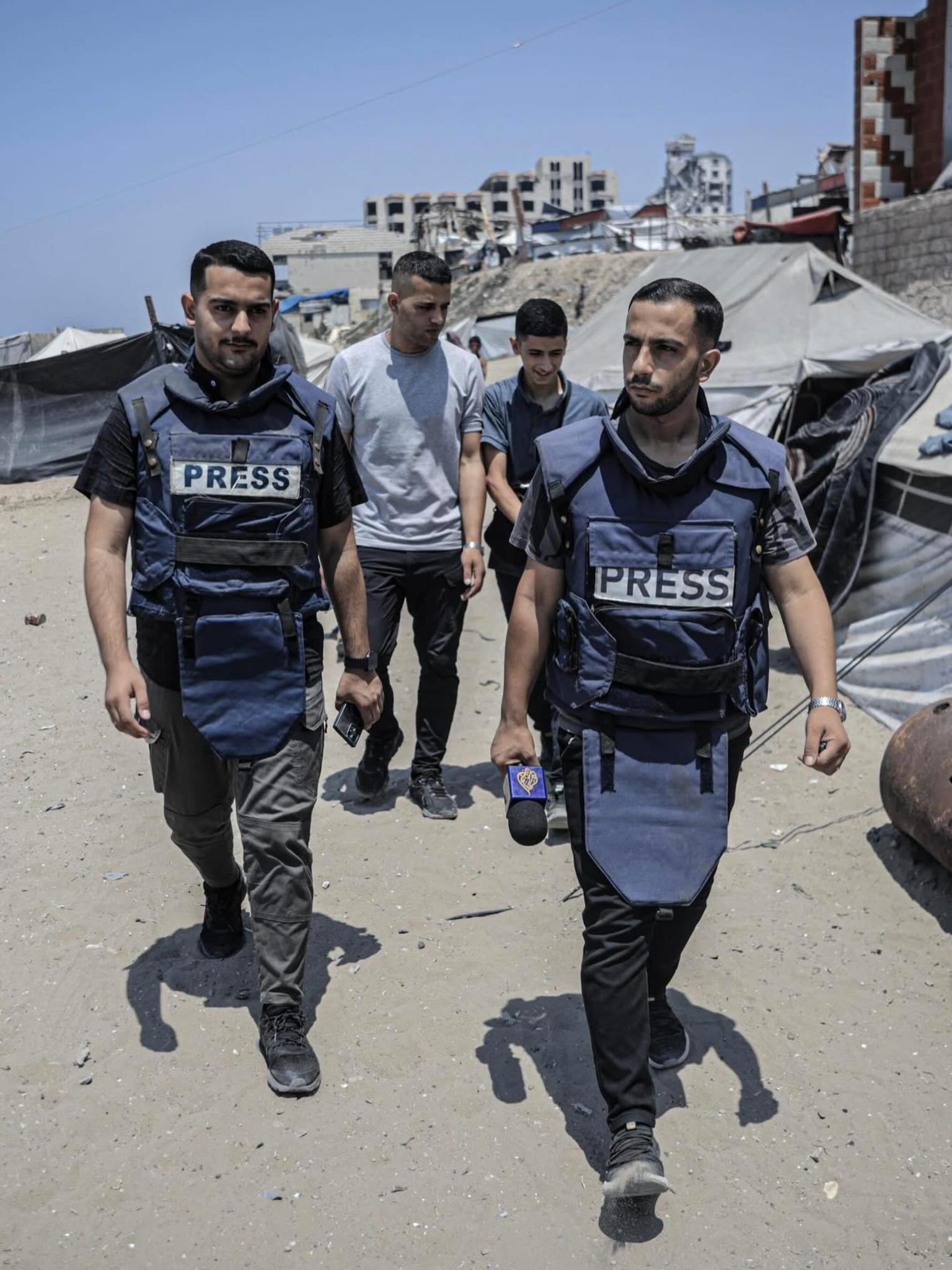
Mahmoud Shalha worked alongside martyred journalist Anas al-Sharif throughout the genocide. This summer, a year after al-Sharif was martyred, Shalha and 23 of his colleagues were fired by Al Jazeera in a shameful and cowardly betrayal.
Shalha submitted the following message as a testament to Gaza’s journalists, whose work continues under unimaginable conditions. His words serve as an introduction to the testimonies from journalists in Gaza about their martyred colleagues contained in this issue — a selection from The Living Record, a substantial oral archive compiled by The New York War Crimes and released in the summer of 2026.
There is nothing in this world more precious to a person than their soul, and our colleagues who have passed away gave their souls and gave themselves for their people, for the truth, and to convey the voice of truth.
If there is a message I wish to share with the world, it is this: Some journalists in Gaza gave their lives, gave themselves, left everything behind, and renounced this world in order to amplify the voice of this oppressed people and to convey the voice of truth and justice.
Although we know full well the magnitude of the danger we face, we will continue the path that our colleagues were on before they passed away. We will continue our work.
I worked as a photographer with my uncle Anas al-Sharif, who had been an Al Jazeera correspondent since the start of Israel’s war on Gaza.
We were covering and documenting events in northern Gaza, specifically in the Jabalia refugee camp and northern Gaza, in the area that witnessed the most intense fighting at the start of the war. The worst of Israel’s genocide was in northern Gaza.
We endured starvation; we endured daily massacres; we endured a human holocaust; we endured murder. There was nowhere to sleep, nothing to eat. There wasn’t even a bathroom to relieve oneself privately.
Life was practically non-existent. With no equipment, no means of communication, no internet, and no way to send or receive the message, and despite the danger — anyone who went online in the north was targeted — we covered the events and risked our lives, climbing to high ground to get a signal on our eSIM cards so we could send our reports and make our voices heard to the world via Al Jazeera’s broadcast.
We sacrificed to deliver sound and images at a time when Al Jazeera’s own people — the staff who had worked with them before the war — had abandoned northern Gaza and Gaza City and fled to the south.
We continued to broadcast the footage and carried on Al Jazeera’s mission; we were its voice and its image from northern Gaza.
After nearly three years of coverage, and after the martyrdom of my colleague, my beloved, and my uncle Anas al-Sharif, as well as my colleagues Mohammed Noufal, Mohammed Qraiqea, Ibrahim Zaher, and Moamen Aliwa — I was the sole survivor of that attack — I had expected Al Jazeera to reward me and ensure my survival. Management had other ideas.
While I was documenting events and sending footage to Al Jazeera, they contacted me to inform me on a call that lasted no more than fifteen seconds, “Your employment has been terminated. Good luck.”
I had no prior notice. They terminated me without paying any dues, without paying anything at all. Just one phone call. “Take care,” they said, “your employment is over, Al Jazeera management.”
When I first received this news, I was shocked and stunned. This is my job, but also my calling. My colleagues gave their lives for it, and I wanted to continue on their path and carry it forward. It is also my source of income for me, my family, my children, and my siblings.
It breaks my heart that they didn’t appreciate our effort, our hard work, and what we’ve lost over the past three years.
It was a huge, huge shock.
I don’t want to stop carrying on the message of the martyrs, the message that my colleague and uncle Anas al-Sharif died for.
I’m still reporting on events and sharing footage through my own platforms — Instagram, Facebook, Twitter, and other social media — so that I can continue to report the truth that my colleagues died for.
To the journalists and colleagues who were martyred while covering the war, this is our pledge and our commitment to you: We will continue to speak of you, to remember your deeds, and to honor the heroism you displayed as you sacrificed your lives for your people.
This piece appears in the twenty-third issue of The New York War Crimes.